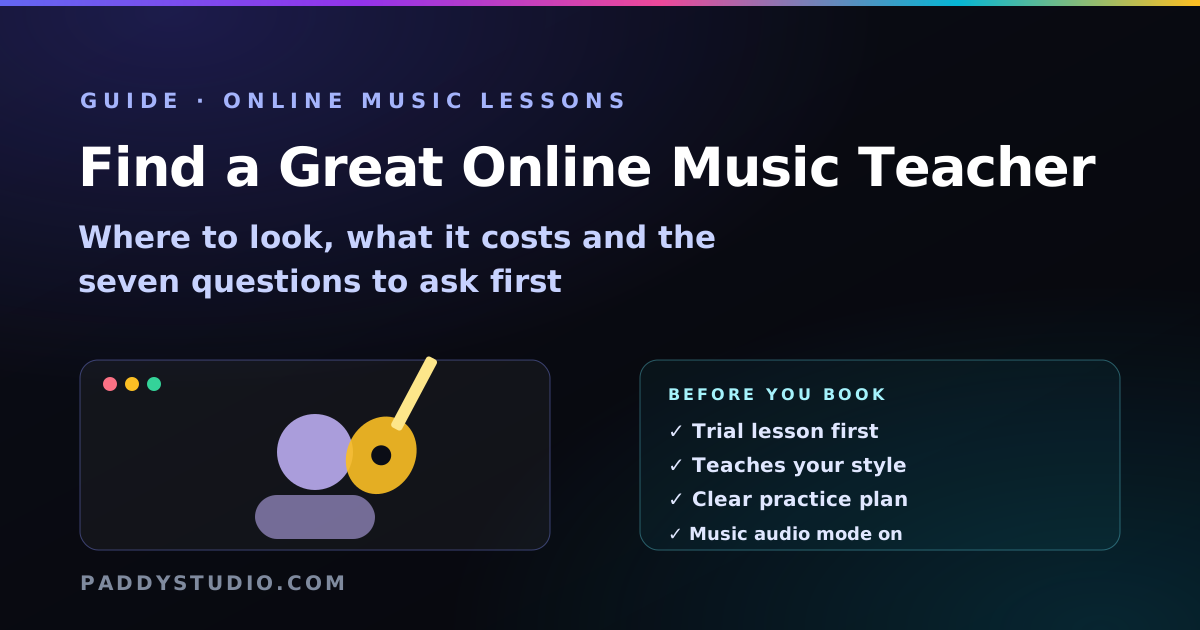
The short answer: find online music teachers through lesson marketplaces (such as Lessonface or Superprof), local music schools that teach over video, and teachers whose free videos you already learn from. Book a short trial lesson, ask about their teaching style, goals and cancellation policy, and judge them on whether you leave the first lesson with one clear thing to practise. Expect to pay roughly what local lessons cost where the teacher lives.
Key takeaways
- Online lessons work for guitar, piano, voice, ukulele, bass, theory, songwriting and production. Drums and orchestral strings are doable, just trickier.
- The teacher matters more than the platform. Use platforms to find people, then judge the person.
- Always take a trial lesson before buying a package.
- A good first lesson ends with a specific goal, a specific exercise and a reason for both.
- Fix your audio first. Wired headphones and the “original sound” setting in your video app make more difference than a better webcam.
Are online music lessons worth it?
For most people, yes. You get access to teachers far beyond your postcode, there’s no driving, lessons can be recorded so you can rewatch them, and teachers can share screens, notation and links in real time. The trade-offs are real but small: a slight audio delay means you can’t play together in perfect time, and a teacher can’t physically adjust your hand position.
| Online | In person | |
|---|---|---|
| Choice of teachers | Worldwide, any style or niche | Whoever is nearby |
| Travel | None | Every week, for you or them |
| Playing together | Hard, because of video latency | Easy and natural |
| Posture and technique fixes | Verbal and visual | Hands-on |
| Recording the lesson | Usually one click | Needs a phone on a stand |
| Best for | Adults, busy schedules, niche styles, theory and production | Young children, drums, early technique |
Where to find online music teachers
1. Lesson marketplaces
Sites such as Lessonface (focused on live online music lessons) and Superprof (a general tutoring marketplace with plenty of music teachers) let you filter by instrument, style, price and reviews, and handle booking and payment. Great for comparing lots of teachers quickly. Read reviews for specifics (“fixed my strumming hand in two weeks”) rather than stars.
2. Local music schools and independent teachers
Lots of local teachers and music schools now teach over video. Search “online [instrument] lessons” plus your city or country. You get someone in your time zone, often with the option of an occasional in-person lesson.
3. Teachers whose free content already helps you
If a YouTube teacher’s explanations click for you, check their channel or website for private lessons. You already know you like how they explain things, which is half the battle.
4. Apps and courses (not teachers, but useful)
Apps like Yousician, Simply or Fender Play, and course sites like Udemy or Skillshare, are structured self-study rather than a teacher. They’re cheap and good for building routine, but they can’t tell you why your wrist hurts. Many people combine an app for daily practice with a monthly lesson for feedback.
How much do online music lessons cost?
Prices vary hugely by country, instrument, the teacher’s experience and lesson length, so treat this as a rough guide rather than a price list. Online teachers usually charge about what local lessons cost where they live.
- Students and newer teachers: the lowest rates, and often brilliant for beginners.
- Experienced private teachers: in the US and UK, commonly somewhere in the region of $30–$80 (or local equivalent) for a 30–60 minute lesson.
- Specialists, conservatoire faculty and well-known players: considerably more.
Ways to spend less: book 30-minute lessons, go fortnightly and practise more in between, try small-group lessons, or buy a package once you’re sure about the teacher (not before).
Cheapest isn’t cheapest. A teacher who costs a bit more but gets you playing a real song in a month is better value than six months of cheap lessons that never quite go anywhere. I took the slow, self-taught road; a good teacher is the shortcut.
Seven questions to ask before you book
- “What would you focus on with someone like me?” A good teacher asks about your goals before answering.
- “Do you teach the style I like?” A classical piano teacher and a pop-chords piano teacher are different jobs.
- “How do you structure lessons?” Listen for a mix of technique, songs and theory, adjusted to you.
- “What do you expect between lessons?” Practice amount, and how they’ll check it.
- “Can I record lessons?” Rewatching is one of online lessons’ biggest advantages.
- “What’s your cancellation and rescheduling policy?” Get it in writing before you pay for a block.
- “What tools or apps will I need?” Most will mention a tuner, a metronome and maybe notation software. (All the basics are in my free online music lesson toolkit.)
Red flags
- Pushes a big prepaid package before you’ve had a single lesson.
- Same lesson plan for everyone, regardless of what you say you want.
- Spends the lesson playing at you rather than watching and listening to you.
- No feedback on technique, ever. Pain or tension is something a good teacher notices.
- You leave lessons without knowing exactly what to practise.
The 15-minute setup that makes video lessons work
- Turn on your video app’s music audio mode. Zoom calls it “original sound for musicians”; other apps have similar options. Without it, the app treats your instrument as background noise and squashes it.
- Wear wired headphones so the teacher’s playing doesn’t feed back into your mic. Bluetooth adds extra delay.
- Frame your hands, not your face. For guitar, the fretting and strumming hands; for piano, a side-on view of the keys and wrists.
- Plug into your router if you can, or sit close to it.
- Tune before the call. Two minutes with a guitar tuner, ukulele tuner or bass tuner saves five minutes of paid lesson time.
- Have a metronome open in another tab. The free online metronome works fine alongside a video call.
What a good first lesson looks like
The teacher asks what music you love and what you want to play. They watch you play something, anything, even badly (that’s fine, it’s their job). They fix one or two of the biggest things, then give you a short, specific practice plan: “this exercise at 70 BPM, this chord change, ten minutes a day”. You leave a bit tired, a bit excited, and clear on what to do next. If that’s how you feel, you’ve found your teacher.
A note for singers
Before your first singing lesson, take a vocal range test. Knowing your lowest and highest comfortable notes helps the teacher pick songs in the right key from day one, and it makes a fun “before” snapshot to compare against in six months.
Frequently asked questions
Where can I find online music teachers?
Lesson marketplaces such as Lessonface and Superprof list music teachers you can filter by instrument, style, price and reviews. Local music schools and independent teachers also teach over video, and many YouTube music teachers offer private lessons through their own websites.
How much do online music lessons cost?
It varies widely by country, instrument, experience and lesson length. In the US and UK, experienced private teachers commonly charge somewhere around $30 to $80 or local equivalent for a 30 to 60 minute lesson, with students and newer teachers charging less and specialists more. Online teachers usually charge about what local lessons cost where they live.
Are online music lessons as good as in-person lessons?
For most adult learners, yes. Online lessons give you a much wider choice of teachers, no travel and easy recording. In-person lessons are better for playing together in time, hands-on technique correction and very young children.
What instruments can you learn online?
Guitar, bass, ukulele, piano and keyboard, voice, music theory, songwriting and music production all work very well online. Drums, violin, cello and wind instruments are also taught online, but technique and sound are harder to judge over video.
What equipment do I need for online music lessons?
A laptop or tablet with a camera, a stable internet connection, wired headphones and your instrument. Turn on your video app's music mode, such as Zoom's original sound for musicians, and position the camera so your hands are clearly visible. An external microphone helps but is not essential.
How do I know if a music teacher is good?
A good teacher asks about your goals, watches and listens to you play, corrects technique, adapts the lesson to you and leaves you with a clear, specific practice plan. Take a trial lesson before paying for a package.
How often should I have music lessons?
Weekly lessons suit most beginners because they keep momentum and catch bad habits early. Fortnightly lessons work well if you practise consistently between them and want to keep costs down.
What free tools help with online music lessons?
A tuner, a metronome, a virtual piano for checking notes and chords, and a drum machine or sequencer for practising with a groove are the essentials. All of them are free in a browser; see the free online music lesson toolkit.
Get your lesson toolkit ready (it's all free)
Tuners, a metronome, a piano keyboard, a vocal range test and a beat to practise over, all in your browser with no signup. Tune up before the call and save your teacher the pain.
Open the free music tools →