
The short version
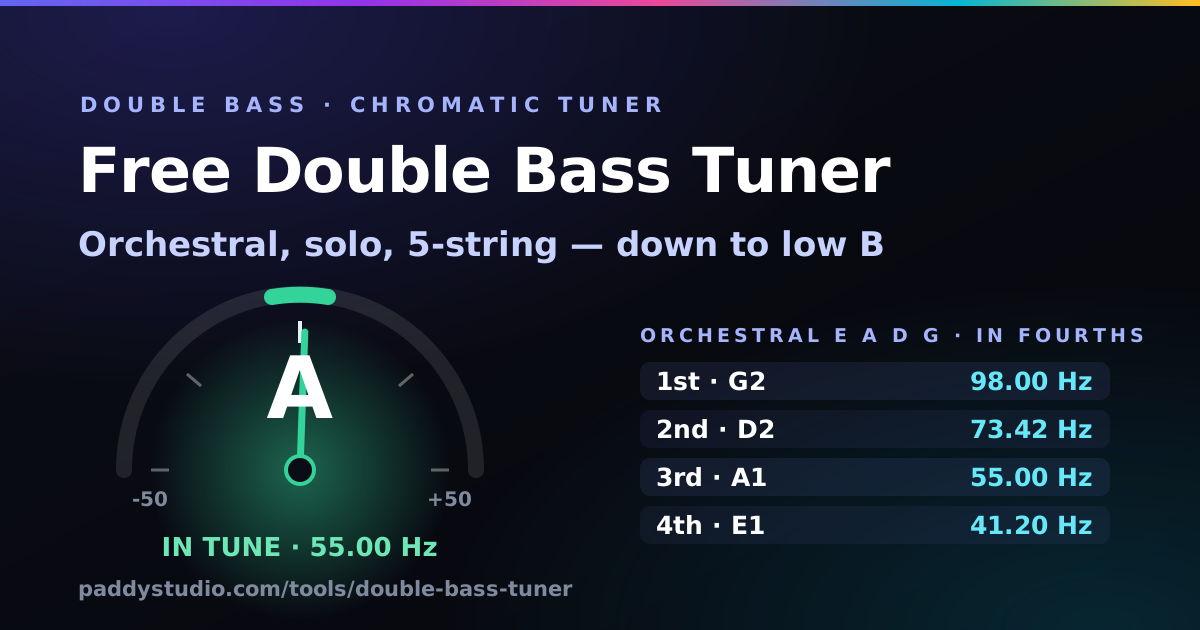
- Standard (orchestral) double bass tuning is E A D G: E1 41.20 Hz, A1 55.00 Hz, D2 73.42 Hz and G2 98.00 Hz, from the lowest string to the highest.
- It is tuned in fourths, not fifths like the violin, viola and cello. Same notes as a bass guitar.
- Solo tuning raises every string a whole step to F♯ B E A, using thinner solo strings.
- Phone mic can’t hear the E? Use Harmonic mode and tune the octave harmonic halfway along the string.
- Pluck and wait half a second. A note at 41 Hz needs a moment to read.
- No microphone? Tap a string pad (or the number keys) for a reference tone and tune by ear.
How to tune a double bass with this tuner
- Press “Start microphone” and accept the browser prompt. Audio is analysed on your device; nothing is recorded or uploaded.
- Pick your tuning. Orchestral E A D G is the default. Solo strings? Choose Solo. Low extension or a fifth string? Choose a 5-string preset.
- Pluck the G string firmly and let it ring. Put your device close to the bass, at f-hole height if you can.
- Turn the machine head the way the tuner says. The pad gets a tick once you hold inside five cents.
- Tune D, A and E. If the E reading wanders, switch on Harmonic mode and use the halfway harmonic instead.
- Go round all the strings again. The bridge and neck shift a little as the tension changes.
Harmonic mode, explained: touch the string very lightly at its exact halfway point (usually around where the neck meets the body), pluck, and lift your finger. You’ll hear a bell-like note one octave above the open string. Small mics hear that far better than the deep open E, and the tuner adjusts its targets automatically.
What are the double bass string notes and frequencies?
Standard orchestral double bass tuning is E1, A1, D2, G2, from the lowest (thickest) string to the highest. The G string is the 1st string and the E string is the 4th. Unlike the rest of the string family, the strings are a perfect fourth apart, which keeps the hand stretches manageable on such a long neck. Bass parts are written an octave higher than they sound, so the music stays on the bass clef staff.
| String | Note | Frequency | What it does |
|---|---|---|---|
| 4th (lowest) | E1 | 41.20 Hz | The lowest note in the orchestra (without an extension) |
| 3rd | A1 | 55.00 Hz | The home of a thousand walking bass lines |
| 2nd | D2 | 73.42 Hz | Warm and round; a lot of melody lives here |
| 1st (highest) | G2 | 98.00 Hz | The top string; where the solos go |
Why is the double bass tuned in fourths?
Because the neck is so long that fifths would need impossible stretches. The double bass is the only member of the orchestral string family tuned in fourths; it inherited this from the viol family. Tuning in fourths means you can reach more notes in one hand position. It is also why upright bass and bass guitar share the same tuning, and why many bass guitarists can find their way around an upright quickly (the left hand is another story).
What is solo tuning?
Solo tuning raises every string a whole step, to F♯1 B1 E2 A2. The extra tension makes the bass brighter and helps it project over an orchestra or piano, which is why most solo double bass repertoire is written for it. Solo strings are thinner and are made to be tuned up; normal orchestral strings tuned up a whole step can be overstressed and may even break.
Don’t crank orchestral strings up to solo tuning. Use a solo set. And whatever the tuning, check that the bridge stays upright after a big change: double bass bridges are tall, and they lean forward as the strings tighten.
Five strings, low B and the C extension
Orchestral music often goes down to C1 (32.70 Hz), below the open E. Bassists get there in two ways: a C extension, which lengthens the E string over the scroll, or a fifth string tuned to low B or low C. Both presets are in the menu. Phone mics are almost deaf at these frequencies, so Harmonic mode is your friend here.
Double Bass tuning chart
Every tuning below is built into the selector at the top of the page. Choosing one updates the pads, the reference tones and the target frequencies.
| Tuning | Notes (low → high) | Frequencies (Hz) | Used for |
|---|---|---|---|
| Orchestral (standard) | E1 A1 D2 G2 | 41.20 · 55.00 · 73.42 · 98.00 | Orchestras, jazz, bluegrass, rockabilly, almost everything |
| Solo tuning | F♯1 B1 E2 A2 | 46.25 · 61.74 · 82.41 · 110.00 | Solo repertoire and recitals (needs solo strings) |
| Five-string, low B | B0 E1 A1 D2 G2 | 30.87 · 41.20 · 55.00 · 73.42 · 98.00 | Five-string basses, mostly in Germany and Austria |
| Five-string, low C | C1 E1 A1 D2 G2 | 32.70 · 41.20 · 55.00 · 73.42 · 98.00 | Five-string basses, low notes in orchestral parts |
| Fifths tuning | C1 G1 D2 A2 | 32.70 · 49.00 · 73.42 · 110.00 | Some jazz and solo players (Red Mitchell) |
Fifths tuning (C G D A) puts the bass an octave below the cello. It gives a bigger range and makes some lines easier, but it needs a special set of strings and a different left-hand technique. The jazz bassist Red Mitchell was its best-known champion.
Why I built this
I'm a guitarist: a Cort, a lot of enthusiasm, roughly twelve notes. I have, however, carried a friend's double bass up three flights of stairs, which I think entitles me to an opinion. My opinion is: after carrying it that far, the last thing you want is a tuner that can't hear the E string.
So I took the low-end engine from my bass guitar tuner, which already reads down to low B, and set it up for the upright: orchestral and solo tuning, five-string presets and a harmonic mode for when your phone mic just shrugs at 41 Hz. Carry your bass carefully. Mind the scroll on door frames.
Using a double bass in a Suno prompt
Upright bass gives an AI track instant warmth. In Suno, say how it is played: “walking upright bass”, “slap upright bass” (rockabilly) or “bowed double bass” (cinematic). Just “bass” usually gets you an electric. Here is a starting style to paste in:
Late-night jazz trio, 120 BPM, walking upright bass, brushed drums, warm jazz piano comping, smoky female vocals, relaxed, intimate, swinging
Recording a real upright over an AI track? Tune to the track first: nudge the A4 control until a reference tone matches the record. The BPM and key finder tells you the key and tempo.
How the detection works, and what it does with your audio
Low notes are hard to detect because they repeat so slowly: the open E repeats only every 24 ms. The tuner filters the microphone signal, then runs a YIN pitch detector on a long, decimated window (about 340 ms), enough for several cycles of even the low B. A “prefer fundamental” check stops it reporting a strong overtone as the note, which is the classic mistake tuners make on bass. A short median filter keeps the needle still. In Bass mode it snaps to the nearest open string; Chromatic mode names any note from about 28 Hz to 500 Hz.
The reference tones are synthesised on the spot with a plucked-string model (Karplus-Strong), so they sound like a pizzicato note rather than a test beep. All of it runs in the browser with the Web Audio API. No audio is recorded, stored or sent anywhere, there's no account, and pressing “Stop microphone” or closing the tab releases the mic immediately. Your tuning choice and A4 setting are saved in your browser's local storage, on your device only.
Double Bass tuning FAQ
What are the notes on a double bass?
E A D G. From the lowest string to the highest: E1 at 41.20 Hz, A1 at 55.00 Hz, D2 at 73.42 Hz and G2 at 98.00 Hz, at a reference pitch of A4 = 440 Hz. This is called orchestral tuning.
Is a double bass tuned the same as a bass guitar?
Yes. Orchestral double bass tuning, E A D G, uses the same notes as a four-string bass guitar.
Why is the double bass tuned in fourths?
Its neck is so long that tuning in fifths, like the violin and cello, would require impossible stretches. Fourths keep more notes within reach of one hand position.
What is double bass solo tuning?
Every string is raised a whole step to F♯ B E A. It makes the bass brighter for solo playing. Use solo strings; orchestral strings are not designed for the extra tension.
Why can’t my phone hear the E string?
Phone and laptop mics barely pick up 41 Hz. Switch on Harmonic mode, touch the string lightly at its halfway point, pluck, and tune the bell-like harmonic, one octave up.
How do I tune a five-string double bass?
Choose “5-string — B E A D G” or “5-string — C E A D G” in the tuning menu. Harmonic mode helps a lot for the low fifth string.
Is this the same as an upright bass tuner?
Yes. Double bass, upright bass, string bass, contrabass and bass fiddle are all names for the same instrument.
Can I tune a double bass without a microphone?
Yes. Tap a string pad, or press the number keys, to hear a plucked reference tone and match it by ear.
Is my microphone audio recorded or uploaded?
No. Pitch detection runs in your browser with the Web Audio API. Nothing is recorded and no audio is sent to any server.
Building a groove around that bass line?
The free Paddy Prompt Studio builds Suno style prompts and Vidmuse video scripts. Pick a genre, mood and vocal and it writes the style line for you.
Open the Prompt Studio →