
The short version
- Count sung vowel sounds, not letters. “Time” is one syllable, “beautiful” is three.
- Most verse lines sit between 6 and 10 syllables; choruses are often shorter and more repetitive.
- Consistency beats any magic number. Lines sung to the same melody should be within one or two syllables of each other.
- Stress matters as much as count. Two 8-syllable lines only sing alike if their strong syllables fall in similar places.
- This page does both for every line as you type, and ignores
[Chorus]tags and(ad-libs).
How to use the syllable counter
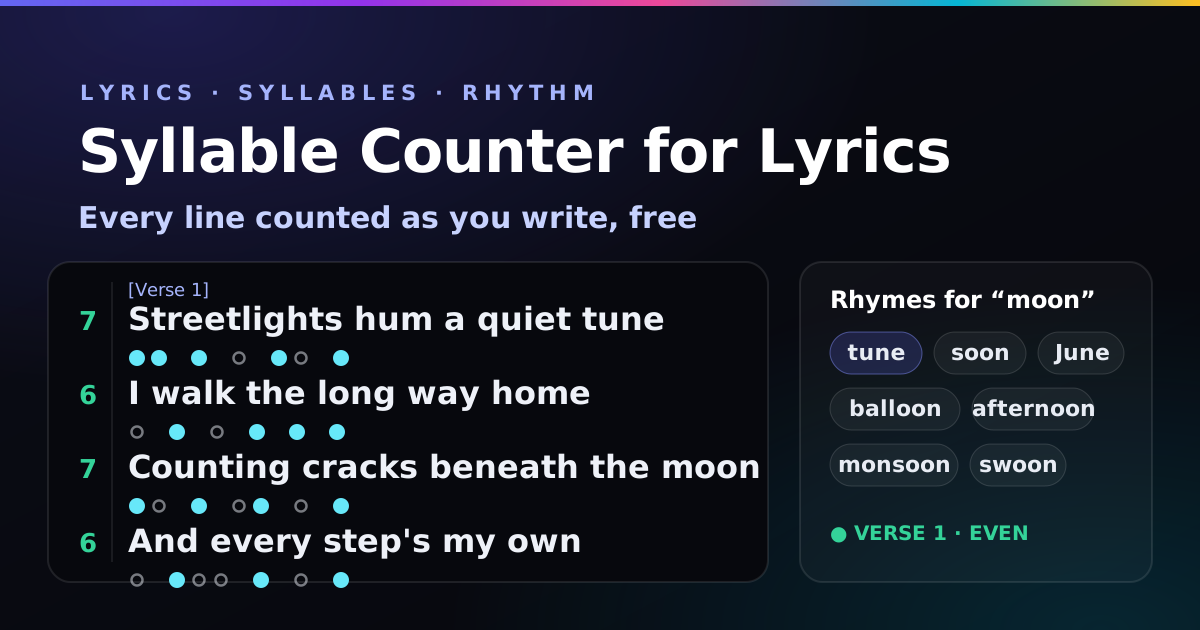
- Type or paste your lyrics. The number in the left margin of each line is its syllable count. It appears instantly and is confirmed against a pronunciation dictionary a moment after you stop typing.
- Mark your sections. Put
[Verse 1],[Pre-Chorus]or[Chorus]on a line of its own. Without tags, a blank line starts a new stanza. Each section is judged on its own, because a chorus is allowed to be shorter than a verse. - Read the colours. Green means the line is within one syllable of its section’s typical length, amber is two off and red is three or more. Type a number into Target / line to measure every line against that number instead.
- Open the Rhythm tab to see each line as a row of beats: filled dots are stressed syllables, rings are unstressed. Select a line there to jump to it in the editor.
- Find rhymes by double-clicking a word, pressing Alt+R (Option+R on a Mac) with the cursor on it, or typing it into the Rhymes tab. Select a rhyme to copy it.
Your draft is saved as you write, in this browser only. Close the tab and it is still here when you come back. Use Copy lyrics to paste into Suno with the tags intact, or Download .txt to keep a copy.
How to count syllables in a song by hand
A syllable is one beat of vowel sound. The spelling does not matter: “strength” has one vowel and one syllable, “idea” has three. When you are away from a screen, these three checks work for almost every word:
- The chin test. Rest your hand under your chin and say the word normally. Each time your jaw drops is a syllable.
- Clap it. Say the line at the speed you would sing it and clap on every vowel sound. The claps are your count.
- Watch the silent letters. A final e is usually silent (“home”, “time”), and -ed only adds a syllable after a t or d (“wanted” is two, “loved” is one).
The words that trip people up are the ones singers bend. The counter shows a range for these, such as 7–8, so you can pick whichever your melody needs.
| Word | Dictionary | Often sung | Sounds like |
|---|---|---|---|
| fire | 2 | 1 | “fyre” |
| every | 3 | 2 | “ev-ry” |
| heaven | 2 | 1 | “heav’n” |
| hour / our | 2 | 1 | “owr” |
| power, flower | 2 | 1 | “powr”, “flowr” |
| really | 2 | 1–2 | “rilly”, “real-ly” |
| family | 3 | 2 | “fam-ly” |
Why matching syllables matter, and why stress matters more
A melody repeats. If verse one’s first line has eight notes, verse two’s first line gets the same eight notes. Give it eleven syllables and something has to give: the singer rushes, slurs two words onto one note, or drops a word altogether. Give it five and words get stretched across beats they were never meant to fill.
Count alone is not the whole story, though. “I walk the long way home” and “Remember what you said” are both six syllables, but one leans on walk, long and home while the other leans on -mem-, what and said. Sung to the same tune, one of them will put the weight on the wrong syllable. That is what the Rhythm tab is for: if two lines that share a melody have their filled dots in similar places, they will sing alike.
A useful rule: keep paired lines within one syllable, and if you have to add one, add an unstressed word (“the”, “and”, “a”), which a singer can tuck into a pickup note without changing the shape of the line.
Writing lyrics that Suno phrases cleanly
AI vocal models like Suno fit your words to a melody they generate, and they behave a lot like a session singer seeing the lyric sheet for the first time. They cope well with tidy, consistent lines and badly with surprises.
- Keep verse lines in the 6–10 range and make paired lines match. A sudden 14-syllable line is the most common reason a generated vocal suddenly rushes.
- Make the chorus shorter and more regular than the verses. Repetition is what makes a hook stick, for listeners and for the model.
- Use tags on their own lines.
[Verse],[Chorus]and[Bridge]tell Suno where the sections are; this counter reads them the same way. - Put backing vocals in round brackets. Suno usually sings
(whoa)or(hold on)as a separate layer, so the counter leaves them out of the main line. - Spell numbers out. “Twenty-four seven” is counted and sung predictably; “24/7” is neither.
The full method, with examples of before-and-after lines, is in the guide to writing lyrics for Suno, and the section tags themselves are explained in Suno song structure and vocal tags. When the words are done, the Prompt Studio builds the matching style prompt.
How the counting works, and what happens to your lyrics
Every word gets an instant estimate from its spelling, so the counts never lag behind your typing. About half a second after you pause, any word the page has not seen before is looked up in the Datamuse dictionary, which returns its syllable count and its pronunciation with stress marks. Those results replace the estimates, and are remembered in your browser so each word is only ever looked up once. Words the dictionary does not know, such as slang and names, keep their estimate and are marked with a ~.
Your lyrics are never uploaded. The draft is stored in your own browser’s local storage. The lookups send single words, never lines or the song, through a small Paddy Studio proxy that caches the dictionary’s answers and does not store what you looked up. There is no account and nothing to install.
Syllable counter FAQ
How do I count syllables in a song?
Count the vowel sounds you actually sing, not the vowel letters. Say the line out loud and tap once per beat of sound: “beau-ti-ful” is three, “time” is one. This page does it automatically for every line as you type, using dictionary pronunciations, and ignores section tags like [Chorus] and ad-libs in brackets.
How many syllables should a line of a song have?
Most pop, rock and country verse lines land between 6 and 10 syllables, and choruses are often shorter. The exact number matters less than consistency: lines sung to the same melody should be within one or two syllables of each other.
Why do matching syllable counts matter?
A melody repeats, so every line sung over it has the same number of notes to fill. A line with too many syllables has to be rushed or crammed; one with too few has to stretch words. Singers, and AI vocal models such as Suno, phrase lyrics more naturally when paired lines match.
What do the dots in the Rhythm tab mean?
Each dot is one syllable. A large filled dot is a stressed syllable, a small filled dot is a secondary stress and a hollow ring is unstressed. Short words like “the”, “a”, “and” and “to” are shown as unstressed because they are almost always sung on a weak beat.
Why does a line show a range like 7–8?
The line contains a flexible word that singers commonly squeeze, such as “fire” (one or two syllables), “every” (two or three) or “heaven” (one or two). The range shows both ways of singing it; choose the one your melody needs.
How accurate is the syllable counter?
Counts for ordinary English words come from a pronunciation dictionary and are accurate. Slang, names and invented words that the dictionary does not know are estimated from their spelling and marked with a tilde (~). Write numbers as words, for example “twenty-four” rather than “24”, so they are counted.
Are my lyrics uploaded or stored?
Your lyrics are saved only in your own browser’s local storage. To look up syllables and rhymes the page sends individual words, never whole lines or the song, to the free Datamuse dictionary through a Paddy Studio proxy that does not store them. No account is needed.
Does this work for Suno lyrics?
Yes. Suno-style section tags like [Verse], [Chorus] and [Bridge] start a new section and are not counted, and text in round brackets, which Suno treats as backing vocals or ad-libs, is dimmed and left out of the count. Copy lyrics copies the text with the tags intact, ready to paste into Suno.
How do I find rhymes for a word?
Double-click or select a word in the editor, press Alt+R (Option+R on a Mac) with the cursor on it, or type it into the Rhymes tab. Perfect rhymes are grouped by syllable count and near rhymes are listed underneath; select one to copy it.