
The short version
- Standard 4-string bass tuning is E1, A1, D2, G2: 41.20, 55.00, 73.42 and 98.00 Hz at A4 = 440 Hz, one octave below the four lowest guitar strings.
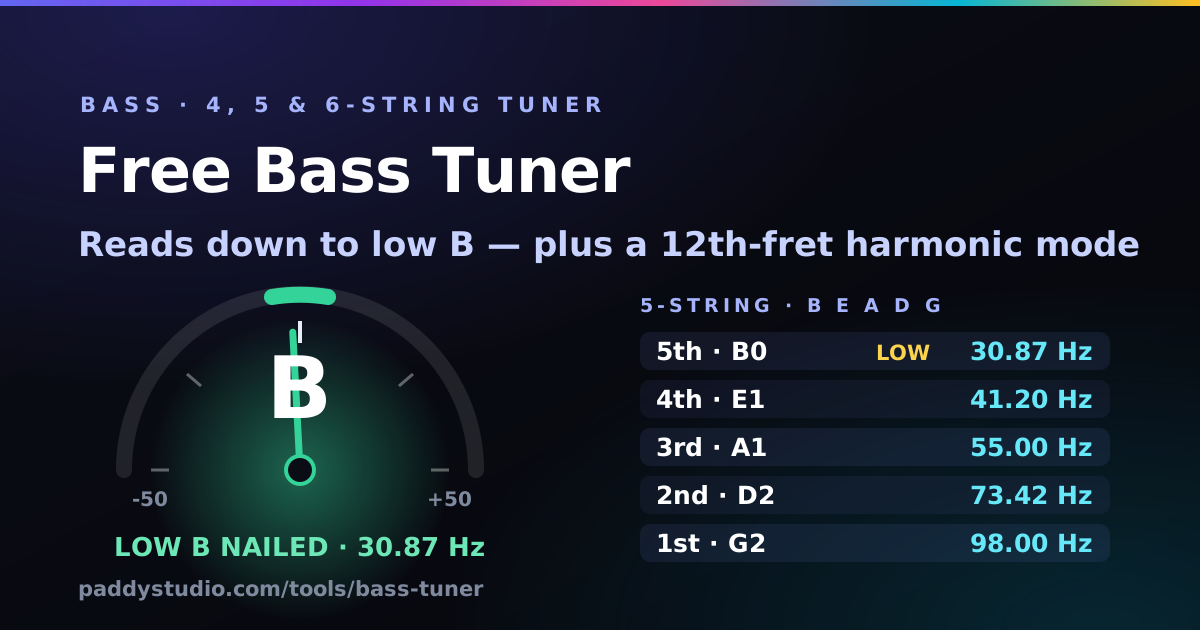
- A 5-string adds a low B0 at 30.87 Hz (B E A D G); a 6-string adds a high C3 at 130.81 Hz on top (B E A D G C).
- Phone and laptop mics roll off below roughly 50–80 Hz, so they barely hear the fundamental of a low B or low E. That is the mic, not your bass.
- If the low string won't read, tune its 12th-fret harmonic. Touch the string lightly over the 12th fret and pluck: the note is exactly one octave up and much easier to hear.
- Let bass notes ring. A low B repeats only about 31 times a second, so a reading needs about a third of a second of clean sound.
- Always tune up to the note, then go round every string again. A bass neck moves as the tension changes.
How to tune a bass with this tuner
- Press “Start microphone” and accept the browser prompt. Audio is analysed on your device; nothing is recorded or uploaded.
- Pick your tuning. 4-string standard is the default; there are also Drop D, half step down, D standard, 5-string (low B), 5-string high C and 6-string.
- Pluck the lowest string firmly close to the microphone and mute the others with your fretting hand. Let it ring: the reading settles after about half a second.
- If it won't read, switch on Harmonic mode. Rest a finger on the string directly over the 12th fret (don't press it down), pluck, and tune the chime instead.
- Turn the peg the way the tuner says, “tighten” if flat, “loosen” if sharp. The pad gets a tick once the string holds inside five cents.
- Repeat for every string, then go round again. The second pass is the one that makes the low end sit right with the band.
Plug in if you can. A bass through an audio interface or a USB bass amp gives the tuner the real low fundamental with no room noise. Choose that input when the browser asks for a microphone. It's the single biggest accuracy win for 5 and 6-string basses.
What are the bass guitar string notes and frequencies?
Standard bass tuning is E1, A1, D2, G2, the same note names as the bottom four guitar strings, one octave lower. Strings are numbered from the thinnest (1st, G) to the thickest, so on a 5-string the low B is the 5th string.
| String | Note | Frequency | 12th-fret harmonic |
|---|---|---|---|
| Low B (5th on a 5-string, 6th on a 6-string) | B0 | 30.87 Hz | B1 · 61.74 Hz |
| E (4th on a 4-string or low-B 5-string; 5th on a high-C 5-string or 6-string) | E1 | 41.20 Hz | E2 · 82.41 Hz |
| A string | A1 | 55.00 Hz | A2 · 110.00 Hz |
| D string | D2 | 73.42 Hz | D3 · 146.83 Hz |
| G string (1st on a 4 or 5-string) | G2 | 98.00 Hz | G3 · 196.00 Hz |
| High C (1st on a 6-string or high-C 5-string) | C3 | 130.81 Hz | C4 · 261.63 Hz |
The string numbers shift with the string count. On a 5-string with a low B, B is the 5th string and E is the 4th. On a 6-string, B is the 6th string and the high C is the 1st. The tuner's pads always show the right numbers for the tuning you pick.
Bass tuning chart: 4, 5 and 6-string
Every tuning below is built into the selector at the top of the page. Choosing one rebuilds the string pads (four, five or six) with the right notes, reference tones and target frequencies.
| Tuning | Notes (low → high) | Frequencies (Hz) | Used for |
|---|---|---|---|
| 4-string standard | E1 A1 D2 G2 | 41.20 · 55.00 · 73.42 · 98.00 | Almost everything |
| Drop D | D1 A1 D2 G2 | 36.71 · 55.00 · 73.42 · 98.00 | Rock and metal riffs, low D in songs |
| Half step down | E♭1 A♭1 D♭2 G♭2 | 38.89 · 51.91 · 69.30 · 92.50 | Matching a guitarist tuned down a half step |
| D standard | D1 G1 C2 F2 | 36.71 · 49.00 · 65.41 · 87.31 | Heavier rock, stoner, grunge |
| 5-string standard | B0 E1 A1 D2 G2 | 30.87 · 41.20 · 55.00 · 73.42 · 98.00 | Modern pop, gospel, metal, worship |
| 5-string high C | E1 A1 D2 G2 C3 | 41.20 · 55.00 · 73.42 · 98.00 · 130.81 | Solos, chords and melodic playing |
| 6-string | B0 E1 A1 D2 G2 C3 | 30.87 · 41.20 · 55.00 · 73.42 · 98.00 · 130.81 | Extended-range jazz, fusion, prog |
Why is the low B so hard to tune with a phone?
Because most phone and laptop microphones barely hear it. Built-in mics are tuned for speech and roll off steeply somewhere below about 50–80 Hz (it varies by device). A low B is 30.87 Hz and a low E is 41.20 Hz, so the fundamental arrives faint or not at all, while the 2nd and 3rd harmonics (62, 93 Hz and up) come through loud. Lots of tuners then lock on to a harmonic and call your B an octave too high, or give up.
This tuner does three things about it. It uses a long analysis window, about a third of a second, so even a 31 Hz note gets ten full cycles to measure. It searches all the way down to 28 Hz, so a low B still reads with A4 lowered to 415. And it favours the fundamental: if the reading looks like a harmonic of a longer period that fits the sound better, it picks the longer one. When even that isn't enough, use the harmonic trick below.
The 12th-fret harmonic trick
- Switch on “Harmonic mode (12th fret)” under the string pads.
- Rest a fingertip on the string directly above the 12th fret wire, touching it lightly without pressing it to the fretboard.
- Pluck firmly near the bridge and lift your finger straight away. You'll hear a clear, bell-like note one octave above the open string: low B becomes B1 at 61.74 Hz.
- Tune to that. The harmonic is exactly double the open string's frequency, so getting it in tune gets the open string in tune.
If you forget to switch modes, the tuner notices when a note sits exactly an octave above one of your strings and suggests it. Turn Harmonic mode off again when you go back to open strings.
Reference tones on small speakers: no phone or laptop speaker can play a true 31 Hz. The pads use a plucked-string sound with plenty of upper harmonics, so you still hear the right pitch, but headphones or a proper speaker make tuning by ear far easier on the low strings.
Five habits that keep a bass in tune
- Tune up, never down. Overshoot, drop clearly below the note, and come back up so the string pulls against the tuner post.
- Stretch new strings. Bass strings are heavy and settle for a day or two. Pull each one gently away from the fretboard, retune, and repeat.
- Go round twice. Bass necks are long, and each string you tighten adds tension that nudges the others flat.
- Check the 12th fret fretted note against the harmonic. If the harmonic is in tune but the fretted note is sharp or flat, the intonation at the bridge saddle needs adjusting.
- Retune after big temperature changes. A bass that came in from a cold van is never still in tune.
Why I built this
I'm a guitarist, which in bass-player terms means I'm the person who borrows your bass, plays it like a guitar, and hands it back out of tune. When I built my guitar tuner I wrote in the FAQ that it couldn't really do bass. That annoyed me enough to fix it properly.
Here's the honest bit: the maths for a low B isn't hard, the microphones are. So the engine here takes a much longer slice of sound than the guitar version, searches down to 28 Hz, and leans towards the fundamental when the harmonics are shouting. And when your phone simply can't hear 31 Hz, it tells you so and switches to the harmonic trick, instead of pretending. Nail the low B and you'll get a little message. You've earned it.
Using bass in a Suno prompt
Suno tends to bury the bass unless you ask for it. Name the playing style (fingerstyle, slap, picked), mention the low B if you want extended range, and ask for a bass-forward mix. Here's a starting style you can paste straight in:
Funk rock, 104 BPM, punchy fingerstyle 5-string electric bass with low B drops, tight pocket with live acoustic drums, crunchy electric guitar stabs, gritty melodic male vocals, bass-forward mix, energetic, gritty, powerful
Recording real bass over a Suno track? Tune to the track first. If it sits slightly off 440 Hz, nudge A4 until a reference tone matches, then tune every string to that.
How the detection works, and what it does with your audio
The tuner filters the microphone signal (a high-pass at 24 Hz to remove rumble, and two low-passes at 700 Hz to tame the upper harmonics), keeps every fourth sample, and analyses a window of roughly a third of a second with a YIN pitch detector. YIN compares the waveform against delayed copies of itself to find the period that repeats, and interpolates between samples to land within about a cent. It then checks whether a period two or three times longer fits clearly better, which catches the classic “bass read an octave high” mistake. A short median filter throws out single bad readings. Bass mode snaps to your open strings; Chromatic mode names any note from about 28 Hz to 500 Hz.
All of that runs in the browser with the Web Audio API. No audio is recorded, stored or sent anywhere, there's no account, and pressing “Stop microphone” or closing the tab releases the mic immediately. Your tuning, A4 and Harmonic-mode settings are saved in your browser's local storage, on your device only.
Bass tuning FAQ
What are the standard bass guitar tuning notes and frequencies?
From the thickest string to the thinnest: E1 41.20 Hz, A1 55.00 Hz, D2 73.42 Hz and G2 98.00 Hz at A4 = 440 Hz. They are the same notes as the four lowest guitar strings, one octave lower.
How do you tune a 5-string bass?
Standard 5-string is B E A D G, adding a low B0 at 30.87 Hz below the usual E1, A1, D2 and G2. Choose “5-string — B E A D G”, tune the low B first, then the rest. If the low B won't read through your mic, use Harmonic mode and tune its 12th-fret harmonic, B1 at 61.74 Hz.
Why won't my phone tuner read the low B or low E string?
Most phone and laptop mics roll off steeply below roughly 50–80 Hz, so they barely hear the fundamental of a low B (30.87 Hz) or low E (41.20 Hz). The harmonics come through, which makes tuners guess wrong. This one uses a long analysis window and favours the fundamental, but if it still struggles, use Harmonic mode or plug the bass into an audio interface.
What is the 12th-fret harmonic trick for tuning bass?
Rest a finger lightly on the string directly above the 12th fret, without pressing down, and pluck. You get a bell-like note exactly one octave above the open string, which mics hear far better. Switch on Harmonic mode and the targets move up an octave to match.
What is Drop D tuning on bass?
Drop D lowers only the 4th string from E1 to D1 (36.71 Hz), giving D A D G. You get a low D and one-finger power-chord shapes on a 4-string. Tune the E down two semitones until the tuner reads D, then check the other three.
What is 5-string high C tuning?
The extra string goes above the G instead of below the E: E A D G C, with the top string at C3 (130.81 Hz). Players who solo, play chords or play melodies pick it over the more common low-B 5-string.
Can I tune a bass without a microphone?
Yes. Tap a string pad, or press the number keys, to hear a plucked reference tone and match it by ear. Small speakers can't reproduce 31–41 Hz, so the tone is voiced with plenty of upper harmonics; your ear still hears the right pitch. Headphones help.
Why does the reading take longer on bass than on guitar?
A low B repeats only about 31 times a second, so the tuner needs a longer slice of sound, about a third of a second, to measure several complete cycles. Let each note ring and read the needle once it settles.
Is my microphone audio recorded or uploaded?
No. Detection happens entirely in your browser, nothing is recorded, and no audio reaches any server. Stop the mic or close the tab and it's released straight away.
Building a track around that bass line?
The free Paddy Prompt Studio builds Suno style prompts and Vidmuse video scripts. Pick a genre, mood, BPM and instruments and it writes the style line for you.
Open the Prompt Studio →