
The short version
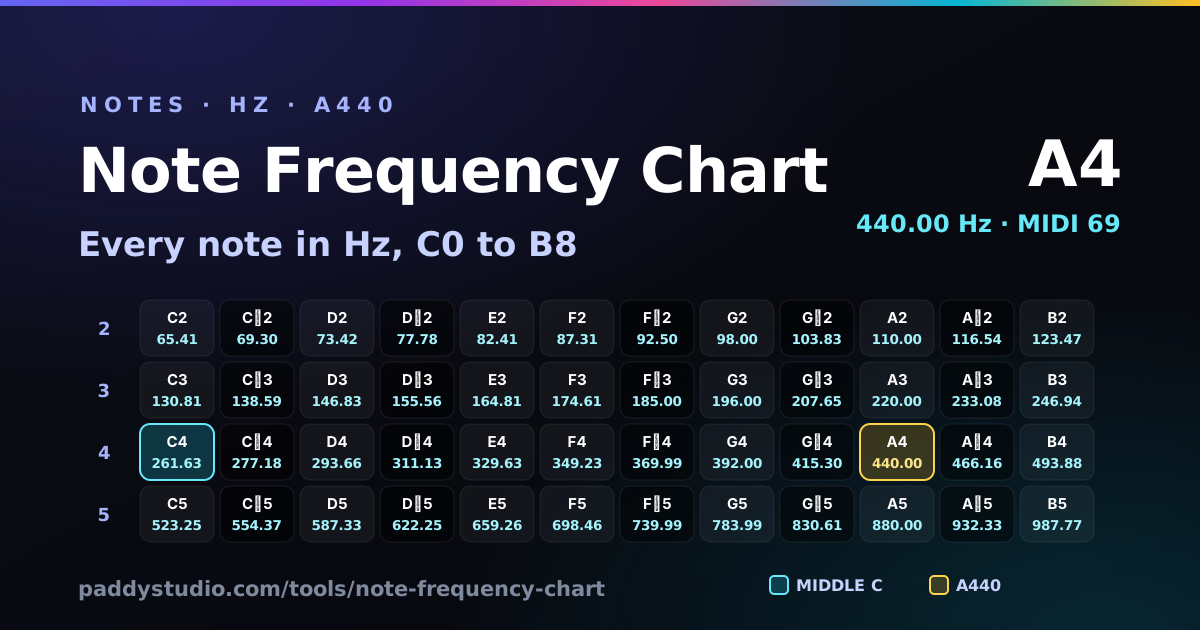
- A4 = 440 Hz is standard tuning (“A440”). Middle C (C4) = 261.63 Hz.
- Every octave doubles the frequency: A3 is 220 Hz, A4 is 440 Hz, A5 is 880 Hz.
- Each semitone multiplies it by about 1.0595 (the twelfth root of two). The formula is f = 440 × 2^((n − 49) / 12), where n is the piano key number.
- A piano runs from A0 (27.50 Hz) to C8 (4186.01 Hz). A guitar’s open strings are E2 82.41, A2 110, D3 146.83, G3 196, B3 246.94 and E4 329.63 Hz.
- A cent is 1/100 of a semitone. Type any frequency above and you get the nearest note plus how many cents sharp or flat it is.
- 432 Hz is a preference, not a secret. It is A tuned about 32 cents flat. Change the reference above to hear the difference.
How do I use the note frequency chart?
Find the note in the chart and read off its frequency, or type a frequency and let the tool name the note. Here’s the full version:
- Check the reference pitch. Leave A4 at 440 Hz for standard tuning, or pick 442, 432 or 415 Hz if your band, orchestra or recording uses something else. Every number on the page updates.
- Look up a note. Find the note in the chart (columns are note names, rows are octaves) or choose it from the note and octave menus. The readout shows its frequency, MIDI number, piano key, wavelength and period.
- Or type a frequency. Type any frequency in hertz, such as 445. The readout names the nearest note and tells you how many cents sharp or flat it is.
- Listen. Tap any cell in the chart, or press Play, to hear a short, soft tone at that pitch. Use the arrow keys to move around the chart.
- Share or export. Copy a link that opens the page at the same note and reference pitch, or copy the whole chart as CSV for a spreadsheet.
Can’t hear the bottom row? That’s your speakers, not your ears. Octave 0 (16–31 Hz) is below what phones and laptops can play, so the tones add a couple of quiet harmonics to give you something to hear. On headphones or a subwoofer you’ll feel C0 more than hear it.
What frequency is middle C?
Middle C (C4) is 261.63 Hz in standard tuning, where A4 is 440 Hz. It is the 40th key on an 88-key piano, MIDI note 60, and sits nine semitones below A4. The C an octave below (C3) is 130.81 Hz, and the C above (C5) is 523.25 Hz.
One small trap: not everyone agrees on the octave number. Scientific pitch notation (what this chart, most teachers and most tuners use) calls middle C “C4”. Some DAWs and keyboards call it C3, and a few call it C5. The note and its frequency are identical; only the label moves.
| Note | Frequency | Piano key | MIDI | Why people look it up |
|---|---|---|---|---|
| A0 | 27.50 Hz | 1 | 21 | Lowest note on a piano |
| E1 | 41.20 Hz | 8 | 28 | Bass guitar low E string |
| E2 | 82.41 Hz | 20 | 40 | Guitar low E string |
| A2 | 110.00 Hz | 25 | 45 | Guitar A string |
| C3 | 130.81 Hz | 28 | 48 | Low C, an octave below middle C |
| C4 | 261.63 Hz | 40 | 60 | Middle C |
| A4 | 440.00 Hz | 49 | 69 | Concert pitch, the tuning note |
| C5 | 523.25 Hz | 52 | 72 | Tenor high C, an octave above middle C |
| A5 | 880.00 Hz | 61 | 81 | One octave above A440 |
| C6 | 1046.50 Hz | 64 | 84 | Soprano high C |
| C8 | 4186.01 Hz | 88 | 108 | Highest note on a piano |
What is A440?
A440 is the agreement that the A above middle C should vibrate 440 times a second. Every other note is then worked out from it. It was settled at an international conference in 1939 and became the ISO 16 standard in 1955, after a couple of centuries in which “A” drifted anywhere from about 400 to over 450 Hz depending on the city and the decade.
It isn’t universal, though. Many orchestras tune slightly higher for a brighter sound, and early-music groups tune lower to match old instruments. Choose any of these in the reference box and the whole chart moves with it:
| A4 | Difference from 440 | Middle C | Who uses it |
|---|---|---|---|
| 440 Hz | — | 261.63 Hz | The standard: tuners, pianos, pop, rock and almost all recorded music |
| 442 Hz | 7.9 cents sharp | 262.81 Hz | Many European orchestras (some go to 443) |
| 432 Hz | 31.8 cents flat | 256.87 Hz | A popular alternative tuning; a matter of taste |
| 415 Hz | 101.3 cents flat (about a semitone) | 246.76 Hz | Baroque ensembles playing period instruments |
How do you calculate the frequency of a note?
Multiply 440 by 2 to the power of (n − 49) ÷ 12, where n is the note’s piano key number. In symbols:
f = 440 × 2^((n − 49) / 12)
Here’s why it works, in plain English. Modern Western tuning (equal temperament) splits each octave into 12 equal steps. An octave is a doubling of frequency, so one semitone is a multiplication by the twelfth root of two: about 1.059463. A4 is key 49, so you count how many semitones your note is from A4 and multiply (or divide) by 1.059463 that many times.
- Middle C: key 40, nine semitones below A4. 440 × 2^(−9/12) = 261.63 Hz.
- E2 (guitar low E): key 20. 440 × 2^(−29/12) = 82.41 Hz.
- Using MIDI numbers instead: f = 440 × 2^((m − 69) / 12), where m is the MIDI note (A4 = 69, middle C = 60).
- Going backwards, Hz to note: n = 12 × log2(f / 440) + 49. Round to the nearest whole number for the note; the leftover, times 100, is how many cents out you are.
- Using a different reference? Swap 440 for your A4, such as 432 or 442.
What are cents in music?
A cent is one hundredth of a semitone, so there are 1200 cents in an octave. Cents measure how far apart two pitches are, and because they’re based on ratios rather than hertz, 10 cents means the same amount of “out of tune” whether you’re on a bass or a piccolo. In hertz, 10 cents is about 0.5 Hz at E2 but about 2.5 Hz at A4.
The formula is cents = 1200 × log2(f2 / f1). Type 445 into the converter and it reports A4, 19.6 cents sharp. As a rough guide, most people can’t pick out a difference of under about 5 cents between two notes played one after the other, but out-of-tune notes played together “beat” against each other, and that wobble is much easier to hear. That’s why tuners aim for within a few cents, and why my guitar sounds fine solo and terrible in a band.
What frequency range does each instrument cover?
Most instruments and voices live between about 40 Hz and 4 kHz for their fundamental notes. Their harmonics go much higher, which is where the brightness and character come from. Here are typical ranges at A4 = 440 Hz; real players and instruments vary, so treat the top ends as “comfortable” rather than “absolute”.
| Instrument or voice | Notes | Frequency range |
|---|---|---|
| Piano (88 keys) | A0 – C8 | 27.50 – 4186.01 Hz |
| Guitar (standard tuning, 22 frets) | E2 – D6 | 82.41 – 1174.66 Hz |
| Bass guitar (4-string, 24 frets) | E1 – G4 | 41.20 – 392.00 Hz |
| 5-string bass, low B | B0 | 30.87 Hz |
| Ukulele (GCEA, to the 12th fret) | C4 – A5 | 261.63 – 880.00 Hz |
| Violin | G3 – E7 | 196.00 – 2637.02 Hz |
| Cello | C2 – A5 | 65.41 – 880.00 Hz |
| Flute | C4 – C7 | 261.63 – 2093.00 Hz |
| Bass voice | E2 – E4 | 82.41 – 329.63 Hz |
| Baritone voice | A2 – A4 | 110.00 – 440.00 Hz |
| Tenor voice | C3 – C5 | 130.81 – 523.25 Hz |
| Alto voice | F3 – F5 | 174.61 – 698.46 Hz |
| Mezzo-soprano voice | A3 – A5 | 220.00 – 880.00 Hz |
| Soprano voice | C4 – C6 | 261.63 – 1046.50 Hz |
| Kick drum (the thump) | Not a fixed note | roughly 50 – 100 Hz |
| Sub-bass and 808s | Often tuned to the song’s key | roughly 30 – 60 Hz |
Not sure which voice type you are? The vocal range test finds your lowest and highest notes and maps them onto this chart.
What are the guitar, bass, ukulele and violin string frequencies?
A guitar in standard tuning is E2 82.41, A2 110.00, D3 146.83, G3 196.00, B3 246.94 and E4 329.63 Hz, from the thickest string to the thinnest. Use the “Highlight open strings” buttons to see any of these on the chart.
| Instrument | Notes | Frequencies (Hz) |
|---|---|---|
| Guitar | E2 A2 D3 G3 B3 E4 | 82.41 · 110.00 · 146.83 · 196.00 · 246.94 · 329.63 |
| Bass guitar | E1 A1 D2 G2 | 41.20 · 55.00 · 73.42 · 98.00 |
| Ukulele (re-entrant) | G4 C4 E4 A4 | 392.00 · 261.63 · 329.63 · 440.00 |
| Violin | G3 D4 A4 E5 | 196.00 · 293.66 · 440.00 · 659.26 |
To actually tune to these, the guitar tuner listens through your mic and tells you which way to turn the peg. If you’d rather hear a note and match it by ear, tap it in the chart above, or hold it as long as you like with the tone generator.
What are wavelength and period?
Wavelength is how far one cycle of the sound travels through air; period is how long one cycle takes. Wavelength = speed of sound ÷ frequency, using 343 metres per second (air at about 20 °C). Period = 1 ÷ frequency.
- A4 (440 Hz): 78.0 cm long, repeating every 2.273 milliseconds.
- Bass guitar low E (41.20 Hz): 8.3 metres. That’s why small rooms struggle with bass, and why bass traps are so big.
- C8 (4186.01 Hz): just 8.2 cm.
Producers use the period too: a delay or a short reverb pre-delay that matches a note’s period (or a multiple of it) can reinforce that pitch. If you’re timing effects to the beat rather than the note, the delay and reverb calculator turns BPM into milliseconds.
Is 432 Hz better than 440 Hz?
No: it’s a preference. A4 = 432 Hz is the same tuning system with everything shifted down by about 32 cents (a third of a semitone). Some people hear it as a touch warmer or more mellow, and if you like it, brilliant: tune to it. But the claims that it’s “the frequency of the universe”, healthier, or mathematically special don’t stand up. There’s no good evidence for any of them, and 432 is only a round number because we happen to count seconds the way we do.
The honest test: set the reference above to 432, tap a few notes, switch back to 440, and tap them again. If you can hear a difference and prefer one, that’s your answer. If you want to play with tunings that really are different, with notes between the piano keys, try the microtonal tuner.
Why I built this
I'm a guitarist: a Cort, a lot of enthusiasm, roughly twelve notes. For years I looked up “what frequency is E2” roughly once a month, landed on a chart that was a blurry JPEG from 2004, squinted at it, and then forgot the answer by the next time. Meanwhile my DAW insisted middle C was C3, my tuner said C4, and I briefly believed I’d lost an octave somewhere.
So here is the chart I wanted: every note, sharp text, the right decimals, and you can tap any of them to hear it. I added the Hz-to-note converter after an EQ plug-in told me my mix had a nasty bump at 196 Hz (it was G3: the open G string on my guitar, ringing out under everything). And I added the reference pitch box so the 432 Hz debate in my comments can be settled by ears rather than by shouting.
Using notes and keys in a Suno prompt
Suno won’t take a frequency, and typing “432 Hz” into the style box won’t reliably retune a song. What does help is naming the key: it nudges the bass, chords and melody towards the same home note. Here’s a starting style to paste in:
Warm lo-fi hip hop, 80 BPM, key of A minor, mellow Rhodes piano, deep round sub bass, dusty boom bap drums, soft vinyl crackle, instrumental, cosy, nostalgic, late night
When the song comes back, check what Suno actually did: the BPM and key finder names the key, and you can find the root note on this chart (A2 is 110 Hz, A1 is 55 Hz for the sub). Want to play along on screen? The online piano keyboard plays every note here.
How it works, and what it does with your data
The chart is plain HTML, worked out with the equal-temperament formula above and rounded to two decimal places, so it reads fine even without JavaScript. When you change the reference pitch, a small script recalculates all 108 notes. Tones come from the Web Audio API built into your browser: a sine wave with two soft harmonics, a quick fade-in so it never clicks, and a gentle fade-out over about a second. The volume is capped well below full scale.
Nothing is recorded or uploaded, and there’s no account. Your reference pitch, note-name and highlight choices and volume are saved in your browser’s local storage, on your device only. Curious how high your own ears go? The hearing test picks up where this chart’s top row leaves off.
Note frequency FAQ
What frequency is middle C?
Middle C (C4) is 261.63 Hz in standard tuning, where A4 is 440 Hz. It is key 40 on an 88-key piano and MIDI note 60. If you tune A4 to 432 Hz, middle C becomes 256.87 Hz.
What is A440?
A440 is the standard tuning reference: the A above middle C (A4) tuned to 440 Hz. It was agreed internationally in 1939 and became the ISO 16 standard in 1955. Tuners, pianos and most recorded music use it.
How do you calculate the frequency of a note?
Use f = 440 × 2^((n − 49) / 12), where n is the piano key number (A4 is key 49). Each semitone multiplies the frequency by the twelfth root of two, about 1.0595, so every octave exactly doubles it.
What are the lowest and highest notes on a piano?
On a standard 88-key piano the lowest note is A0 at 27.50 Hz and the highest is C8 at 4186.01 Hz, with A4 at 440 Hz.
What are the frequencies of the guitar strings?
In standard tuning, from the thickest string: E2 82.41 Hz, A2 110.00 Hz, D3 146.83 Hz, G3 196.00 Hz, B3 246.94 Hz and E4 329.63 Hz.
How many cents are in a semitone?
There are 100 cents in an equal-tempered semitone and 1200 in an octave. The difference between two frequencies in cents is 1200 × log2(f2 / f1).
Is C sharp the same frequency as D flat?
Yes, in equal temperament, which is how pianos, guitars and this chart are tuned. C♯ and D♭ are two names for the same key and the same frequency. Which name you use depends on the key of the music.
Is 432 Hz better than 440 Hz?
No, it is a matter of taste. A4 = 432 Hz is about 32 cents flatter than 440 Hz, which some people hear as slightly warmer. There is no good scientific evidence that it is healthier or more natural.
Why do some apps call middle C “C3”?
Octave numbering is a convention, not physics. Scientific pitch notation calls middle C “C4”, but some DAWs and MIDI gear, including Yamaha and FL Studio, label it C3 or even C5. The frequency, 261.63 Hz, is the same whatever the label.
Can I download or share the note frequency chart?
Yes. “Copy CSV” and “Download CSV” export all 108 notes from C0 to B8 at your chosen reference pitch, and “Copy link” shares the page set to the same note and A4.
Got the notes, now want the song?
The free Paddy Prompt Studio builds Suno style prompts and Vidmuse video scripts. Pick a genre, key, mood and vocal and it writes the style line for you.
Open the Prompt Studio →