
The short version
- There is no fixed price per stream. Streaming services pool their revenue and pay rights holders by their share of streams, so a “per-stream rate” is an average outcome that moves with country, subscriber tier and time.
- Spotify is commonly estimated at about $0.003–$0.005 per stream to the recording rights holder, roughly $3–$5 per 1,000 streams before a distributor or label takes a cut.
- $1,000 from Spotify takes about 250,000 streams at an estimated $0.004 per stream, and more after commission or a label split.
- Spotify pays nothing on a track with fewer than 1,000 streams in the previous 12 months. That rule has applied to recorded royalties since early 2024.
- Your distributor model matters over time: a flat annual fee with 0% commission, or a percentage of every stream for as long as the track earns.
- This is only the recording side. Songwriter royalties (performance and mechanical) are collected separately, through a PRO and a mechanical society or publishing administrator.
How to use the streaming royalty calculator
- Pick a direction. “Streams → earnings” tells you what a number of streams might pay; “Earnings → streams” tells you how many streams a target needs.
- Enter your streams or your target, and say whether it is per month or per year. You always get both back.
- Check the rates and the stream split. If your distributor dashboard shows your own per-platform figures, type them in. Drag the sliders to match where your listeners actually are.
- Add your distributor, fees and splits. Pick a commission model, type your current annual fee if you pay one, and enter your share after any label or collaborator split.
- Leave the Spotify rule on and enter your track count, then read the monthly and yearly estimate. Copy a summary, or copy a share link that opens with the same numbers.
Working backwards is the fun bit. Switch to “Earnings → streams” and tap “A coffee” or “Your monthly rent”. The example prices are editable, because a London flat and a Lisbon flat are not the same number.
How do streaming royalties work?
Streaming royalties are paid from a pool, not per play. Each month a service like Spotify takes the money it collected in a market from subscriptions and adverts, keeps its own share, and splits the rest between rights holders according to their share of all the streams in that market. This is usually called the pro-rata or “streamshare” model.
There are two separate sets of rights in every song:
- Recording (master) royalties go to whoever owns the recording, normally the artist or their label. Independent artists receive these through their distributor. This calculator estimates this part.
- Publishing royalties go to the songwriters and publishers for the composition itself: the melody and lyrics. They are collected through different organisations and paid separately.
Because the pool and your share of it change every month, the per-stream rate is an average outcome, worked out afterwards, not a fixed price anyone sets in advance. That’s why every number on this page is an estimate.
How much does Spotify pay per stream?
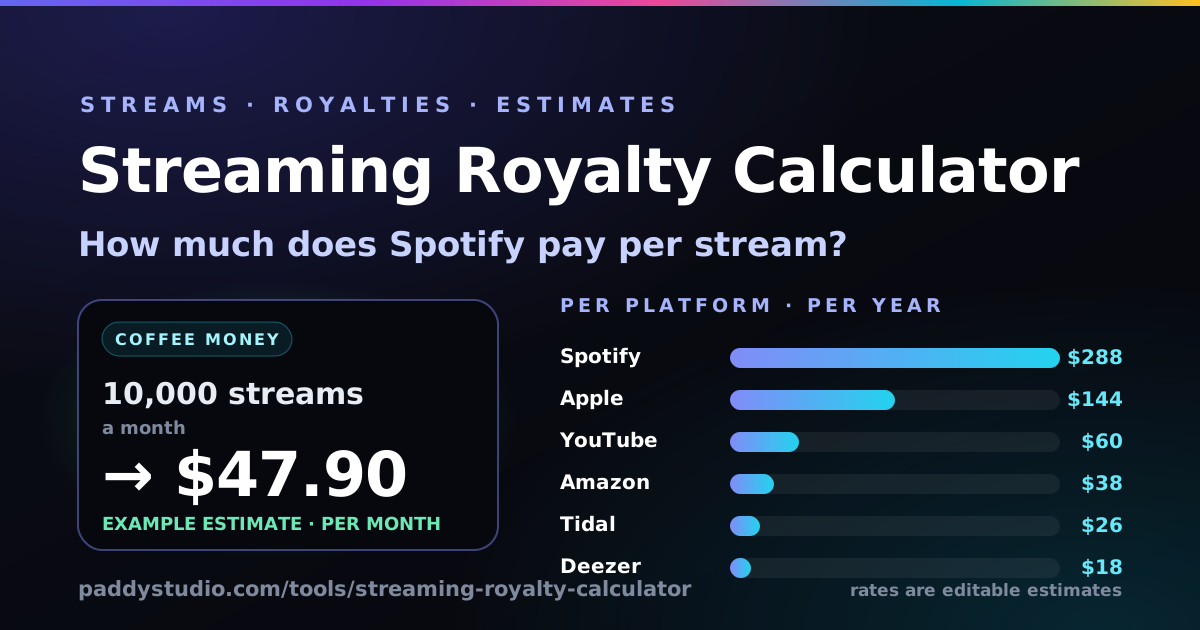
Spotify is commonly estimated to pay about $0.003 to $0.005 per stream to the recording rights holder, so 1,000 streams is roughly $3 to $5 before your distributor or label takes anything. The table below collects the ranges that are widely quoted for each service. Treat them as ballparks; your own statements are the only real numbers.
| Platform | Estimated range | Calculator default | Per 1,000 streams at default |
|---|---|---|---|
| Spotify | ~$0.003–$0.005 | $0.004 | ~$4 |
| Apple Music | ~$0.006–$0.01 | $0.008 | ~$8 |
| YouTube Music | ~$0.002–$0.008 | $0.005 | ~$5 |
| Amazon Music | ~$0.004 | $0.004 | ~$4 |
| Deezer | ~$0.002–$0.004 | $0.003 | ~$3 |
| Tidal | ~$0.009–$0.013 | $0.011 | ~$11 |
And here is the same thing the other way round, using only the $0.004 Spotify estimate with no fees or splits. It’s plain arithmetic, not data, but it’s the question everyone actually asks.
| Target | Streams needed | Watch out for |
|---|---|---|
| $1 | 250 | Below 1,000 a year on one track, Spotify pays nothing |
| $10 | 2,500 | Spread over three or more tracks, each falls under 1,000 |
| $100 | 25,000 | Fine on one track; over 25 tracks it is right on the line |
| $1,000 | 250,000 | A 20% commission makes it about 312,500 |
| $10,000 | 2,500,000 | Usually a playlist or a lot of catalogue, not one lucky week |
Why do per-stream numbers differ so much?
Two artists with the same stream count can be paid quite different amounts. The usual reasons:
- Country. Subscription prices differ around the world, so a stream in a high-price market is worth more than one in a lower-price market.
- Subscriber or free tier. Paid subscribers generate more revenue per stream than ad-supported listeners, so an audience that is mostly on the free tier pulls your average down.
- Your listeners’ share of streams. In a pro-rata pool you are paid on your share of all streams in a market, so the same streams can be worth a little more or less depending on how much everyone else streamed that month.
- Currency. Royalties are often earned in many currencies and converted, so exchange rates nudge the final figure.
- Time. Prices, deals and policies change, which is why any per-stream figure online, including mine, has a shelf life.
What does a distributor take?
As an independent artist you can’t upload straight to Spotify; a distributor delivers your music and collects your royalties. There are three common models: an annual fee with 0% commission (you keep all the royalties and pay a yearly subscription), a fee per release, or a commission on every royalty payment. Commissions in the 10–20% range are common, which is why the presets are 15% and 20%.
A flat fee looks better the more you release and the more you earn; a commission can be cheaper if you release once and earn very little. I’ve deliberately not put any distributor’s price in the calculator, because prices change. If the annual-fee model suits you, DistroKid (affiliate link) is the best-known one, and I compare it properly in DistroKid for Suno artists. Type your current plan’s price into the fee box. If you’re weighing one up, I went through the flat-fee model in DistroKid for Suno artists.
A fee can make the answer negative. If your yearly fee is bigger than your royalties, the calculator shows you out of pocket. That’s not a bug, it’s the honest maths of a small catalogue.
What about publishing and mechanical royalties?
If you wrote the song, you’re owed songwriter royalties on top of the recording royalties, and they don’t come through your distributor. Performance royalties are collected by a performing rights organisation (PRO), so songwriters register with their local one. Mechanical royalties from streams are collected by mechanical rights organisations, and many independent writers use a publishing administrator to register their songs and chase both. It’s paperwork, but it’s money that otherwise goes unclaimed. This calculator doesn’t include any of it.
What is Spotify’s 1,000-stream rule?
Since early 2024, a track has to reach at least 1,000 streams in the previous 12 months before Spotify pays recorded royalties on it. Streams on tracks below the line earn nothing from Spotify; the money stays in the pool for everyone else.
That hits big catalogues of quiet tracks hardest, which is exactly what a lot of AI music looks like. The calculator spreads your Spotify streams evenly across the number of tracks you enter: if that works out under 1,000 a year each, Spotify pays nothing and you get a warning. Real catalogues are uneven, so a couple of your tracks may clear the line while the rest don’t. Check Spotify for Artists for the current rules, because they can change.
Streaming royalties for AI music
Royalties work the same for an AI-assisted track as for any other, but there are two extra checks before you release one:
- Your Suno plan. Suno’s paid plans grant commercial-use rights to songs made while you’re subscribed; free-plan songs are for personal, non-commercial use. It’s the plan you were on when you made the song that counts. Check Suno’s current terms, and see can you sell Suno songs? for the full picture.
- Platform and distributor policies. Each distributor and streaming service has its own AI-content rules, often including a disclosure question at upload. Read them and answer honestly. The rules on spam and impersonation are in can you put AI music on Spotify?
Why I built this, and realistic expectations
I’m a self-taught guitarist who makes Suno songs about angels and spirits. Some of them are on streaming services. They earn pocket change, the sort you find down the back of the sofa, and I’m not going to dress that up with a screenshot.
I built this because every time I looked up “how much does Spotify pay” I got a single confident number and no context. Here’s the honest bit: no calculator can tell you what you’ll earn, because nobody knows the rate in advance. What it can do is show you the shape of it: how many streams things really take, what the 1,000-stream rule does to a big catalogue of quiet tracks, and how much a commission or a split costs over time. If the answer is “three coffees a year”, it’s better to know before you plan your retirement around it.
For the routes that tend to pay better than streams, such as licensing, commissions and building an audience, see how to make money with AI music.
Making music that people keep streaming
Streams come from listening habits, not uploads. The lanes where AI tracks tend to do well are functional, mood-led ones: focus, sleep, lo-fi and ambient playlists people leave running. If you’re building a catalogue, pick one lane and keep the sound consistent. A simple starting style for Suno is lo-fi hip hop, 80 BPM, Rhodes electric piano, drum machine, ambient reverb pads, relaxed, dreamy, instrumental.
Before you release anything, give it a proper master. The LUFS meter checks your track’s loudness against streaming targets, right in the browser.
How it works, and what it does with your data
For each platform, the calculator multiplies your streams by that platform’s share of the split and by its per-stream estimate. If the Spotify rule is on, it divides your yearly Spotify streams by your track count and drops Spotify to zero when that is under 1,000. It then takes off the distributor commission, applies your share after splits, subtracts any annual fee, and converts with your exchange rate. Working backwards, it searches for the smallest whole number of streams that reaches your target. That way the Spotify rule and the fee are handled exactly, and not with a rough division.
All of the maths runs in your browser. Nothing you type is sent anywhere, the calculator makes no network requests, and there is no account. Your settings are saved in your browser’s local storage so they’re there next time; clear your site data to remove them. A share link puts the numbers in the address, so only share it if you’re happy for whoever opens it to see them.
Streaming royalties FAQ
How much does Spotify pay per stream?
There’s no fixed price. Spotify pays rights holders a share of revenue based on their share of streams, so the effective rate varies by country, subscriber tier and month. Commonly cited estimates put it at roughly $0.003 to $0.005 per stream to the recording rights holder, about $3 to $5 per 1,000 streams before a distributor or label takes its cut.
How many streams do you need to make $1,000 on Spotify?
At an estimated $0.004 per stream, about 250,000 Spotify streams, before any commission or split. At $0.003 it’s about 333,000 and at $0.005 about 200,000. Each track also needs at least 1,000 streams in the previous 12 months to earn anything from Spotify.
Why does Spotify pay nothing for some of my tracks?
Since early 2024 Spotify only pays recorded royalties on tracks that reached at least 1,000 streams in the previous 12 months. Streams on tracks below that line earn nothing from Spotify. Check Spotify for Artists for the current rules.
Which streaming service pays the most per stream?
In commonly cited estimates, Tidal and Apple Music sit above Spotify per stream, and Deezer a little below. But per-stream rate isn’t total income: a service where more of your listeners stream can pay more overall at a lower rate.
How much does a music distributor take?
It depends on the model: an annual fee with 0% commission, a fee per release, or a percentage of your royalties, often 10–20%. Prices and terms change, so check your distributor’s current plan and type the numbers into the calculator.
Does this include songwriting and publishing royalties?
No. It estimates recorded (master) royalties paid through your distributor. Performance royalties are collected by a PRO you register with, and mechanical royalties by a mechanical society or a publishing administrator.
Can I earn streaming royalties from Suno songs?
Generally yes, if you made them while on a paid Suno plan, which grants commercial-use rights to songs made while subscribed. Free-plan songs are personal, non-commercial use only. Check Suno’s current terms, plus your distributor’s and each platform’s AI-content policies.
Are the exchange rates live?
No. The calculator makes no network calls, so the exchange rates are rough defaults. Type today’s rate into the box next to the currency. Per-stream rates are entered in US dollars.
Is my data sent anywhere?
No. The maths runs in your browser and settings are saved in local storage on your device. A share link only carries the numbers you choose to share, in the address itself.
Make the next track worth streaming
The free Paddy Prompt Studio builds Suno style prompts and Vidmuse video scripts, so you can spend less time guessing tags and more time finishing songs.
Open the Prompt Studio →