
The short version
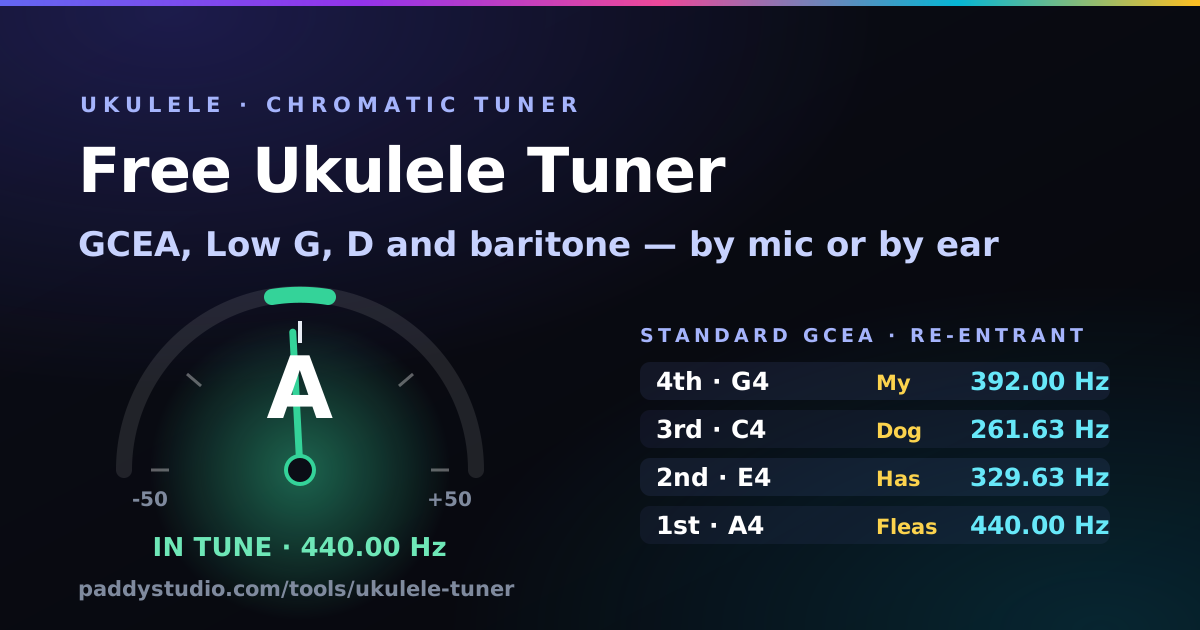
- Standard ukulele tuning is G C E A: G4 392.00 Hz, C4 261.63 Hz, E4 329.63 Hz and A4 440.00 Hz, from the 4th string to the 1st, at A4 = 440 Hz.
- The 4th string is nearest your chin and the 1st string is nearest the floor when you hold the uke to play.
- Standard tuning is re-entrant: the G is higher than the C and E beside it, which is why the open strings sing “My Dog Has Fleas”.
- Soprano, concert and tenor all use GCEA. Baritone ukuleles are tuned D G B E, like the top four strings of a guitar.
- New nylon strings go flat for days. Stretch them gently and retune; it typically takes a few days to a week to settle.
- No microphone? Tap a string pad (or keys 1–4) for a plucked reference tone and tune by ear.
How to tune a ukulele with this tuner
- Press “Start microphone” and accept the browser prompt. Audio is analysed on your device; nothing is recorded or uploaded.
- Pick your tuning. Standard GCEA is the default and right for most soprano, concert and tenor ukes. Choose Low G if your 4th string is the thick, low one, or Baritone if you play a baritone.
- Pluck the 4th string (G) on its own, the one nearest your chin. Hold the uke close to the mic: nylon is quiet.
- Read the needle once the note settles. Turn the peg the way the tuner says, “tighten” if you are flat, “loosen” if you are sharp. The pad gets a tick when you hold inside five cents.
- Do C, E and A the same way, then go round all four again, because nylon stretches as you tune.
- Press “My Dog Has Fleas” and strum along string by string. If it sounds the same, you are done.
No mic, or a noisy room? Tap a string pad to hear a plucked reference tone, then match your uke to it by ear. Keys 1–4 do the same: 1 is the A string nearest the floor and 4 is the G nearest your chin.
What are the ukulele string notes and frequencies?
Standard ukulele tuning is G4, C4, E4, A4, read from the 4th string to the 1st. Strings are numbered from the one nearest the floor (1st, A) to the one nearest your chin (4th, G). That is the same numbering guitarists use, just with four strings.
| String | Note | Frequency | “My Dog Has Fleas” |
|---|---|---|---|
| 4th (nearest your chin) | G4 | 392.00 Hz | My |
| 3rd | C4 (middle C) | 261.63 Hz | dog |
| 2nd | E4 | 329.63 Hz | has |
| 1st (nearest the floor) | A4 | 440.00 Hz | fleas |
What is re-entrant tuning?
Re-entrant tuning means the strings don't run from lowest to highest. On a standard uke the 4th string G4 (392 Hz) is higher than the C4 and E4 next to it; only the A on the 1st string is higher. Play the open strings in order and the pitch drops, then climbs: G down to C, up to E, up to A. That is the shape of “My Dog Has Fleas”, and it is why the open strings sound like a little tune rather than a scale.
It also explains the sound. Because all four strings sit inside about one octave, chords come out tight and bright, with no big bass note underneath. That sparkly, close strum is the ukulele sound. Low G (linear) tuning drops the 4th string to G3 (196 Hz) for a deeper range and walking bass lines, at the cost of some of that sparkle. Neither is “correct”. Have a go with both.
Ukulele tuning chart
Every tuning below is built into the selector at the top of the page. Choosing one updates the pads, the reference tones and the target frequencies.
| Tuning | Notes (4th → 1st) | Frequencies (Hz) | Used on |
|---|---|---|---|
| Standard (high G, re-entrant) | G4 C4 E4 A4 | 392.00 · 261.63 · 329.63 · 440.00 | Soprano, concert, tenor |
| Low G (linear) | G3 C4 E4 A4 | 196.00 · 261.63 · 329.63 · 440.00 | Tenor and concert, fingerstyle |
| D tuning (re-entrant) | A4 D4 F♯4 B4 | 440.00 · 293.66 · 369.99 · 493.88 | Soprano, older method books |
| Baritone | D3 G3 B3 E4 | 146.83 · 196.00 · 246.94 · 329.63 | Baritone ukulele |
| Bass ukulele (use the bass tuner) | E1 A1 D2 G2 | 41.20 · 55.00 · 73.42 · 98.00 | Bass ukulele, U-Bass style |
D tuning is a whole step above standard: every string is two semitones higher, so it still sings “My Dog Has Fleas”, just brighter. If your strings feel tight in D tuning, that is why. The bass ukulele row is there for reference. Those notes are too low for this tuner, so use the free bass tuner, which is built for them.
Soprano, concert, tenor or baritone: which tuning does my uke use?
Soprano, concert and tenor ukuleles all use G C E A; the baritone is the odd one out with D G B E. Size changes the scale length (the vibrating length of the string), which changes the tone and the feel more than the notes.
| Size | Scale length (approx.) | Usual tuning | Character |
|---|---|---|---|
| Soprano | ~33 cm (13 in) | GCEA, high G | The classic plinky sound; tight frets |
| Concert | ~38 cm (15 in) | GCEA, high or low G | A little louder and roomier |
| Tenor | ~43 cm (17 in) | GCEA, often low G | Fuller, more sustain; popular for fingerstyle |
| Baritone | ~48 cm (19 in) | DGBE | Deep and warm; chord shapes match guitar |
Low G needs a low-G string. Don't try to tune a normal high-G string down an octave. It will flop and buzz. Low G sets use a thicker (often wound) 4th string. Likewise, a baritone needs baritone strings; a soprano set won't reach D G B E.
Why do new ukulele strings keep going flat?
Because nylon and fluorocarbon stretch, a lot more than steel guitar strings. A fresh set keeps going flat every time you tune it, for anywhere from a few days to about a week depending on the strings and how much you play. Nothing is broken. It's just physics being slow.
- Tune up, then stretch. Hook a finger under each string and pull it gently away from the fretboard, a few spots along its length. Retune. Repeat until the pitch stops dropping.
- Tune slightly sharp overnight for the first couple of days if you like. The strings will drift down towards pitch while you sleep.
- Always tune up to the note. If you overshoot, drop below and come back up, so the string is pulling against the peg.
- Temperature and humidity move nylon too. A uke that went from a cold car to a warm room needs a retune before you play.
Why I built this
I'm a guitarist: a Cort, a lot of enthusiasm, roughly twelve notes. Hand a guitarist a ukulele and two things happen. First, every chord shape is wrong. Second, the tuning makes no sense, because the string that looks lowest is actually high. My first instinct was to tune that G down an octave “to fix it”. Please don't do that.
So I took the engine from my guitar tuner, taught it to count to four instead of six, and gave the reference tones a softer, plucked-nylon sound so they sound like a uke and not a test beep. The “My Dog Has Fleas” button is pure indulgence. Here's the honest bit: I still play the uke like a guitarist who's been shrunk in the wash. But at least now it's in tune.
Using a ukulele in a Suno prompt
If you're layering a real uke take over an AI backing, or you just want that sunny strum in a Suno track, name the instrument and how it is played. “Ukulele” alone tends to get generic. “Bright re-entrant ukulele strumming” and “fingerpicked ukulele” steer it much better. Here's a starting style you can paste straight in:
Acoustic ukulele pop, 100 BPM, bright re-entrant GCEA ukulele strumming, fingerpicked ukulele fills, handclaps, clean melodic female vocals, playful, uplifting, catchy
Recording your own uke over a Suno track? Tune to the track first. If the song sits a little off 440 Hz, nudge the A4 control until a reference tone matches the record, then tune all four strings to that.
How the detection works, and what it does with your audio
The tuner band-limits the microphone signal so rumble and high overtones can't fool the maths, then runs a YIN pitch detector. It compares the waveform against delayed copies of itself to find the period that repeats, then interpolates between samples to land within about a cent. A short median filter throws out single bad readings, which is why the needle sits still instead of twitching. In Ukulele mode it snaps to the nearest of your four open strings; Chromatic mode names any note between roughly 100 Hz and 1100 Hz.
The reference tones are synthesised on the spot with a plucked-string model (Karplus-Strong), voiced soft and warm like a nylon string. All of it runs in the browser with the Web Audio API. No audio is recorded, stored or sent anywhere, there's no account, and pressing “Stop microphone” or closing the tab releases the mic immediately. Your tuning choice and A4 setting are saved in your browser's local storage, on your device only.
Ukulele tuning FAQ
What are the standard ukulele tuning notes?
G C E A. From the 4th string (nearest your chin) to the 1st (nearest the floor): G4 392.00 Hz, C4 261.63 Hz, E4 329.63 Hz and A4 440.00 Hz at A4 = 440 Hz. It is the same for soprano, concert and most tenor ukuleles.
What does re-entrant tuning mean?
The strings don't run in order from lowest to highest. On a standard uke the 4th string G is tuned higher than the C and E next to it, so the pitch jumps back up on the first string you play. That high G is what gives the ukulele its bright, close-voiced strum.
Why do people say “My Dog Has Fleas”?
It's a memory aid sung to the four open strings G, C, E and A in order. If your uke is in tune, plucking the strings one by one fits the tune of “My Dog Has Fleas”. Press the button under the tuner to hear how it should sound.
Which string is the 4th string on a ukulele?
Hold the uke in playing position: the 4th string is nearest your chin and the 1st is nearest the floor. On a standard ukulele the 4th is G, the 3rd is C, the 2nd is E and the 1st is A.
What is the difference between high G and low G?
High G (G4, 392 Hz) is the traditional re-entrant tuning. Low G drops the 4th string an octave to G3 (196 Hz) for a deeper, fuller range like a small guitar. Low G needs a thicker 4th string, usually wound, so you can't just tune a high-G string down an octave.
Is tenor or concert ukulele tuning different?
No. Soprano, concert and tenor all use G C E A; tenor players are just more likely to choose Low G. Only the baritone is different: D G B E, like the top four strings of a guitar.
Why does my new ukulele keep going out of tune?
New nylon or fluorocarbon strings stretch a lot, so they go flat again and again for the first few days to a week. That's normal. Tune up, gently pull each string away from the fretboard, retune, and repeat. Once they settle they hold pitch far better.
Can I tune a ukulele without a microphone?
Yes. Tap any of the four string pads, or press keys 1–4, to hear a plucked reference tone and match it by ear. Handy when mic permission is blocked or the room is loud.
Can I tune a bass ukulele with this?
Not well. A bass ukulele is tuned E1 A1 D2 G2, the same as a bass guitar, which is below this tuner's search range. Use the free bass tuner instead; it has a longer analysis window for low notes.
Is my microphone audio recorded or uploaded?
No. Detection happens entirely in your browser, nothing is recorded, and no audio reaches any server. Stop the mic or close the tab and it's released straight away.
Making a song around that strum?
The free Paddy Prompt Studio builds Suno style prompts and Vidmuse video scripts. Pick a genre, mood and vocal and it writes the style line for you.
Open the Prompt Studio →