
The short version
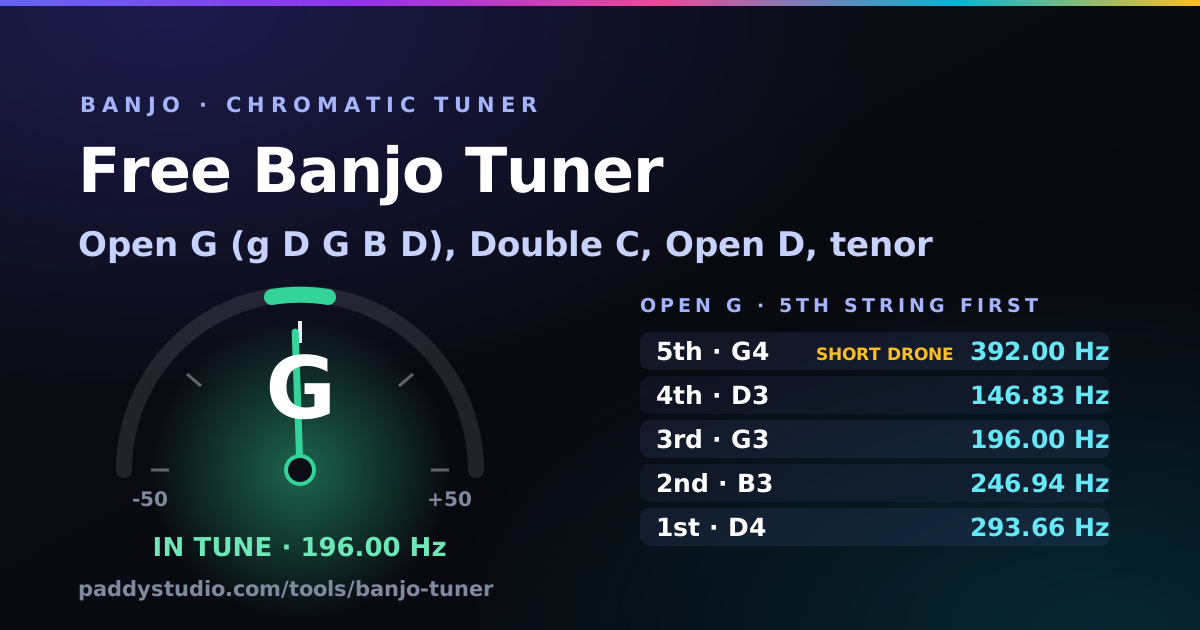
- Standard 5-string banjo tuning is Open G, g D G B D: G4 392.00 Hz, D3 146.83 Hz, G3 196.00 Hz, B3 246.94 Hz and D4 293.66 Hz, from the 5th string to the 1st.
- The short 5th string is the highest note, not the lowest. It’s a thumb-plucked drone, and it’s why the first “g” is written small.
- Strum the open strings and you get a G chord. If it sounds sour, one string is out.
- Tune the 3rd string (G) first, then the 5th an octave above it, then D, B and the top D.
- Using a capo? Raise the 5th string by the same number of frets, with a spike, a 5th-string capo or the peg.
- Tenor banjo? Pick C G D A or Irish G D A E in the menu. No microphone? Tap a pad (or keys 1–5) and tune by ear.
How do I tune a banjo with this tuner?
Tune one open string at a time, starting from the 3rd string, then strum to check the chord. Here’s the routine for Open G:
- Press “Start microphone” and say yes to the browser prompt. The audio is analysed on your device and goes nowhere else.
- Pick the 3rd string (G3) on its own and let it ring. Turn the peg the way the tuner says: “tighten” if flat, “loosen” if sharp.
- Tune the short 5th string to G4, an octave above. Its peg is the odd one out, halfway up the neck.
- Tune the 4th (D3), 2nd (B3) and 1st (D4) the same way. Each pad gets a tick once the string holds the green zone.
- Go round all five again. The head and floating bridge flex as you tighten, so the first strings drift a touch.
- Press “Play a roll”, then strum the open strings yourself. One clean G chord means you’re done.
Pick gently and let it settle. A banjo is loud and very bright, and a hard pick stroke goes sharp for a moment before the note settles. Pluck with the flesh of your thumb, rest your palm lightly on the other strings, and read the needle after the first twang. Arm’s length from the mic is plenty. Possibly the next room.
What are the banjo string notes and frequencies?
Standard 5-string banjo tuning is Open G: g D G B D. Strings are numbered from the floor up, so the 1st string is the thin D nearest your toes and the 5th is the short one by your thumb. Strummed open, the five strings make a G major chord, which is why so many banjo tunes are in G.
| String | Note | Frequency | What it does |
|---|---|---|---|
| 5th (short drone) | G4 | 392.00 Hz | Highest open note; the thumb drone that rings over everything |
| 4th | D3 | 146.83 Hz | Lowest note, the only wound string on most sets |
| 3rd | G3 | 196.00 Hz | The root of the G chord; tune it first |
| 2nd | B3 | 246.94 Hz | The major third that makes the chord sound cheerful |
| 1st | D4 | 293.66 Hz | Top melody string; 5th fret matches the open 5th string |
No tuner? Tune the banjo to itself. Once the 4th string is right, fret it at the 5th fret to get the open 3rd string (G3). Fret the 3rd string at the 4th fret for the open 2nd (B3). Fret the 2nd string at the 3rd fret for the open 1st (D4). Fret the 1st string at the 5th fret for the open 5th string (G4).
Why is the 5th string short and tuned so high?
The 5th string is a drone: it starts at the 5th fret, it’s tuned to G4, the highest open note on the banjo, and your thumb plucks it between melody notes. Tuning a string out of pitch order like this is called re-entrant tuning, the same trick as a high-G ukulele. That bright, constant g is a big part of why a banjo sounds like a banjo. The diagram above draws it thin and puts it at the top, where it sits on the neck.
- Its peg is on the side of the neck, around the 5th fret. It’s a short string, so a tiny turn changes the pitch a lot.
- It snaps more than the others. Thin, short and tuned high: bring it up slowly, and never past G4 without a reason.
- It doesn’t care about your capo. A normal capo only covers four strings, so the 5th has to be raised separately (next section).
How do I tune the 5th string when I use a capo?
Raise the 5th string by the same number of frets as the capo. Capo at the 2nd fret puts the banjo in A, so the 5th string goes from G4 up to A4 (440.00 Hz). Capo at the 4th fret (key of B) wants B4; capo at the 5th fret (key of C) wants C5.
- Railroad spikes: tiny hooks hammered into the fingerboard, usually at the 7th, 9th and 10th frets. Tuck the 5th string under one and it’s raised by two, four or five frets: A, B or C.
- A sliding 5th-string capo does the same job on a little rail along the side of the neck.
- Or just turn the peg up, then check it in Chromatic mode, because Banjo mode expects the open G.
Retune after you clamp a capo on. A capo pulls the strings slightly sharp, more so on a tall-fretted banjo. Fit it, then do a quick lap with the tuner in Chromatic mode. And mind the bridge: banjo bridges are held on by string pressure alone. If one falls over, every string goes with it, and you get to learn where it lives. I’ve heard.
What are the other banjo tunings?
Open G handles most bluegrass. Clawhammer and old-time players change tunings from tune to tune, and the 4-string tenor banjo has its own. Choosing a tuning updates the pads, the reference tones and the target frequencies, including switching between five and four strings.
| Tuning | Notes | Frequencies (Hz) | Used for |
|---|---|---|---|
| Open G (standard) | G4 D3 G3 B3 D4 | 392.00 · 146.83 · 196.00 · 246.94 · 293.66 | Bluegrass, Scruggs-style rolls, most songs in G |
| Double C | G4 C3 G3 C4 D4 | 392.00 · 130.81 · 196.00 · 261.63 · 293.66 | Clawhammer tunes in C (and D with a capo at 2) |
| C tuning (drop C) | G4 C3 G3 B3 D4 | 392.00 · 130.81 · 196.00 · 246.94 · 293.66 | Tunes in C, classic-style and parlour pieces |
| Open D | F♯4 D3 F♯3 A3 D4 | 369.99 · 146.83 · 185.00 · 220.00 · 293.66 | Tunes in D; many players spike the 5th up to A instead |
| Sawmill (G modal) | G4 D3 G3 C4 D4 | 392.00 · 146.83 · 196.00 · 261.63 · 293.66 | Modal old-time tunes, that eerie, lonesome sound |
| Tenor banjo | C3 G3 D4 A4 | 130.81 · 196.00 · 293.66 · 440.00 | 4-string tenor: jazz, Dixieland, chord melody |
| Irish tenor | G2 D3 A3 E4 | 98.00 · 146.83 · 220.00 · 329.63 | 4-string tenor for Irish sessions, an octave below a fiddle |
| 6-string banjo (guitjo) | E2 A2 D3 G3 B3 E4 | 82.41 · 110.00 · 146.83 · 196.00 · 246.94 · 329.63 | Guitar tuning on a banjo body; use the guitar tuner |
What about tenor and 6-string banjos?
A tenor banjo has four strings, no short drone, and is tuned in fifths: usually C G D A, or G D A E for Irish music. Both are in the tuning menu, and the pads switch to four when you pick one. A 6-string banjo (a guitjo or banjitar) is a guitar in a banjo’s clothes: tuned E A D G B E, played with guitar chord shapes. My guitar tuner is the right tool for that one, and the guitar chord charts work on it unchanged.
Why I built this
I'm a guitarist: a Cort, a lot of enthusiasm, roughly twelve notes. I own no banjo. I have, however, heard every banjo joke. What’s the difference between a banjo and an onion? Nobody cries when you chop up a banjo. How long does it take to tune a banjo? Nobody knows. Banjo players tell these better than anyone, usually right before playing something so fast and clean it shuts the whole pub up.
The tuning joke stuck with me, though, because the banjo really is a bit fiddly: a string that starts halfway up the neck and is tuned highest, a capo that ignores it, and a drum head that changes pitch when it rains. So I took the engine from my guitar tuner and gave it banjo manners: the 5th string drawn in its real place, a bright plucky reference tone, and old-time tunings one click away. Now we know how long it takes. About three minutes.
How do I use a banjo in a Suno prompt?
Say what style of banjo playing you want. “Banjo” alone can come out as a vague plinky texture. “Scruggs-style three-finger banjo rolls” sounds like bluegrass; “clawhammer banjo” sounds like an old-time porch at dusk. Here’s a starting style to paste in:
Driving bluegrass, 132 BPM, Scruggs-style three-finger banjo rolls in open G, fiddle fills, flatpicked acoustic guitar, upright bass, high lonesome vocal harmonies, energetic, playful, live room
Recording a real banjo over an AI backing? Tune to the track first. If the song isn’t quite at 440 Hz, nudge the A4 control until a reference tone matches the record, then tune every string to that. The BPM and key finder tells you the key (and whether you need the capo), and the tempo changer slows a breakdown down so you can learn it.
How does the detection work, and what happens to my audio?
The tuner filters the microphone signal to cut rumble and the sizzle of the head’s overtones, then runs a YIN pitch detector. YIN compares the waveform with delayed copies of itself to find the period that repeats, then interpolates between samples to land within about a cent. A short median filter discards odd readings, and a fundamental check stops a bright string from being read an octave high. In Banjo mode it snaps to the nearest open string, so the 3rd string (G3) and the 5th (G4) never get mixed up; Chromatic mode names any note from about 90 Hz to 1000 Hz.
The reference tones are synthesised on the spot with a plucked-string model (Karplus-Strong), voiced bright and short like a banjo. It all runs in the browser with the Web Audio API. Nothing is recorded, stored or sent anywhere, there’s no account, and pressing “Stop microphone” or closing the tab releases the mic straight away. Your tuning choice and A4 setting are saved in your browser’s local storage, on your device only.
Banjo tuning FAQ
What are the notes on a 5-string banjo?
In standard Open G tuning the strings are g D G B D. From the 5th string to the 1st: G4 at 392.00 Hz, D3 at 146.83 Hz, G3 at 196.00 Hz, B3 at 246.94 Hz and D4 at 293.66 Hz, at a reference pitch of A4 = 440 Hz. Strummed open, they make a G major chord.
Why is the 5th banjo string shorter and higher than the others?
The 5th string is a short drone string that starts at the 5th fret and is tuned to G4, the highest open note on the banjo. This is called re-entrant tuning. You pluck it with your thumb, so it rings above the melody between the other notes.
Which banjo string should I tune first?
Start with the 3rd string, G3. It is the root of the Open G chord, and the short 5th string is the same note an octave higher, so once the G is right you can tune the 5th string and then the D and B strings around it.
How do I tune the 5th string when I use a capo?
Raise it by the same number of frets as the capo. With the capo at the 2nd fret for the key of A, the 5th string goes up to A4 at 440.00 Hz. Use a 5th-string capo, or railroad spikes at the 7th, 9th and 10th frets, or tune it up and check it in Chromatic mode.
What is Double C tuning on a banjo?
Double C is g C G C D: G4, C3, G3, C4 and D4. From Open G you lower the 4th string from D to C and raise the 2nd string from B to C. It is a favourite clawhammer tuning for tunes in C, and in D with a capo at the 2nd fret.
How is a tenor banjo tuned?
A 4-string tenor banjo is usually tuned C G D A in fifths: C3 at 130.81 Hz, G3 at 196.00 Hz, D4 at 293.66 Hz and A4 at 440.00 Hz. Irish players often tune it G D A E instead, an octave below a fiddle. Both tunings are in the tuning menu.
How do I tune a 6-string banjo?
A 6-string banjo, sometimes called a guitjo or banjitar, is tuned exactly like a guitar: E A D G B E, from E2 at 82.41 Hz to E4 at 329.63 Hz. Use the guitar tuner for it, because that page is set up for the low E string.
Why does my banjo go out of tune so easily?
A banjo head is basically a drum skin, so changes in humidity and temperature change its tension and the pitch with it. New strings stretch, and the floating bridge can creep. Tune before you play, then check again after a few minutes.
Can I tune a banjo without a microphone?
Yes. Tap any of the string pads, or press keys 1 to 5, to hear a plucked reference tone and tune each string to it by ear.
Is my microphone audio recorded or uploaded?
No. The pitch detection runs inside your browser using the Web Audio API. Nothing is recorded, stored or sent to a server.
Hearing banjo in your next song?
The free Paddy Prompt Studio builds Suno style prompts and Vidmuse video scripts. Pick a genre, mood and vocal and it writes the style line for you, rolls and all.
Open the Prompt Studio →