
The short version
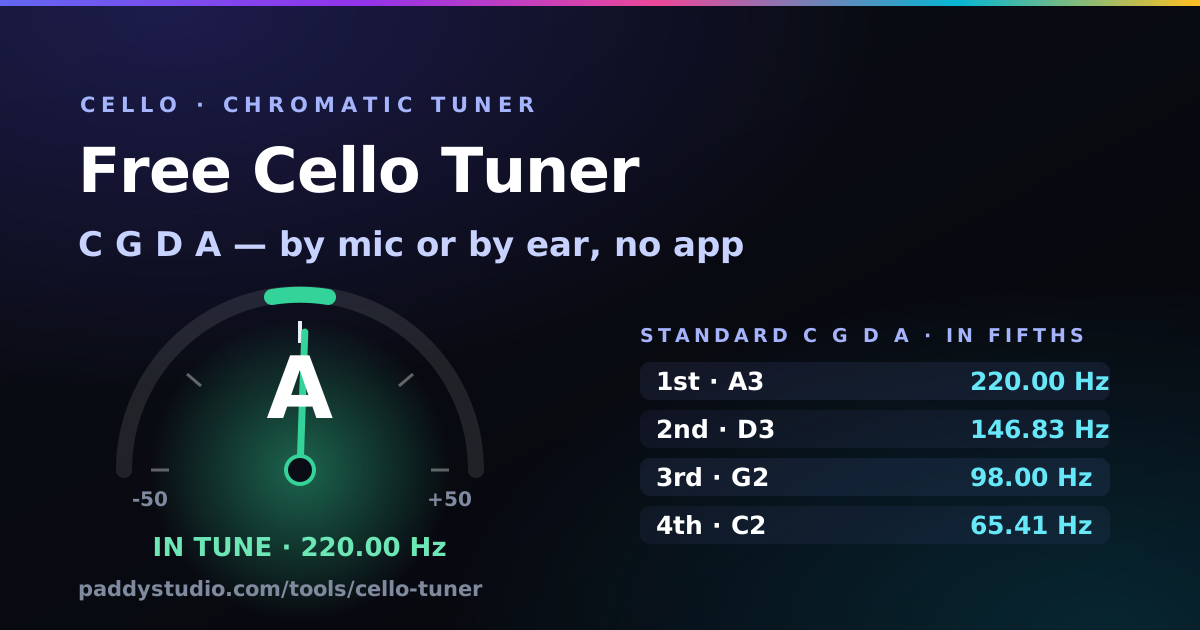
- Standard cello tuning is C G D A: C2 65.41 Hz, G2 98.00 Hz, D3 146.83 Hz and A3 220.00 Hz, from the lowest string to the highest.
- It’s the viola’s tuning, one octave lower. The strings are a perfect fifth apart.
- Tune the A string first, then D, G and C.
- The cello’s A is A3 (220 Hz), one octave below the orchestra’s tuning A of 440 Hz. That’s normal; it’s the same note.
- Low C needs a moment. Bow firmly and hold it for half a second; small mics hear low notes weakly.
- No microphone? Tap a string pad (or keys 1–4) for a pizzicato reference tone and tune by ear.
How to tune a cello with this tuner
- Press “Start microphone” and accept the browser prompt. Audio is analysed on your device; nothing is recorded or uploaded.
- Check the reference pitch. 440 Hz is standard; many orchestras use 442. Press + to match.
- Bow or pluck the A string on its own. Put the device on a stand or chair near the f-holes, not on the floor behind you.
- Turn the fine tuner or peg the way the tuner says. The pad gets a tick once you hold inside five cents.
- Work down: D, G, then C. Hold each low note for a moment; the reading settles as the string rings.
- Go round all of them again, then press “Play all strings” to hear the fifths.
Phone on the music stand? Perfect. Cellos project forwards from the f-holes, so a device on the stand in front of you hears the low strings far better than one on the floor beside the endpin. If the C still wanders, pluck it firmly and let it ring.
What are the cello string notes and frequencies?
Standard cello tuning is C2, G2, D3, A3, from the lowest (thickest) string to the highest. The A string is the 1st string and the C string is the 4th. Each string is a perfect fifth above the one below it. Cello music is written mostly in bass clef, with tenor and treble clef for the high passages.
| String | Note | Frequency | What it does |
|---|---|---|---|
| 4th (lowest) | C2 | 65.41 Hz | The lowest note on the cello; deep and resonant |
| 3rd | G2 | 98.00 Hz | Rich and warm; lots of bass lines live here |
| 2nd | D3 | 146.83 Hz | The singing middle of the instrument |
| 1st (highest) | A3 | 220.00 Hz | The tuning reference and the bright melody string |
Pegs or fine tuners: which should I turn?
Fine tuners for small changes, pegs for anything more than about a semitone. Most student cellos have fine tuners on all four strings; many professional cellos only have one on the A. Clockwise raises the pitch, anticlockwise lowers it.
- Turning a peg: the cello pegs are big and stiff. Loosen slightly, then bring the string up to pitch while pushing the peg into the pegbox so it holds.
- Fine tuner bottomed out? Unscrew it back to the middle of its travel and make up the difference with the peg.
- Check that the fine tuner isn’t touching the top of the cello. A tuner screwed all the way in can scratch the varnish.
Watch the bridge. Tuning up drags the top of the bridge towards the fingerboard. If it starts to lean, ease it back gently, or ask your teacher or a luthier. A cello bridge falling over is loud, alarming, and an expensive way to learn this lesson.
How to check the fifths by ear
Once the needle says each string is right, play neighbours together: C with G, G with D, D with A. A pure fifth sounds still and smooth. If you hear a slow “wah-wah” beating, one string is slightly out; the faster the beat, the further off it is. Cellists often check with harmonics too: the harmonic halfway up one string should match the harmonic a third of the way up the next.
Why is the low C hard to tune with a phone?
Because small microphones barely hear 65 Hz. Phone and laptop mics are built for voices, so they roll off the deep fundamental and mostly pick up the C string’s overtones. A simple tuner then reports the wrong octave, or shows nothing. This one uses a long analysis window and a “prefer fundamental” check, so it can usually find the real note. If it still struggles, move the device closer to the f-holes, bow firmly, or tune the C by listening to the fifth against your in-tune G.
Cello tuning chart
Standard tuning covers almost everything. The others are for two famous pieces and for five-string cellos. Choosing one updates the pads, the reference tones and the target frequencies.
| Tuning | Notes (low → high) | Frequencies (Hz) | Used for |
|---|---|---|---|
| Standard | C2 G2 D3 A3 | 65.41 · 98.00 · 146.83 · 220.00 | Everything: orchestral, chamber, solo, pop |
| Bach Suite No. 5 scordatura | C2 G2 D3 G3 | 65.41 · 98.00 · 146.83 · 196.00 | Bach’s Cello Suite No. 5 in C minor |
| Kodály Sonata Op. 8 | B1 F♯2 D3 A3 | 61.74 · 92.50 · 146.83 · 220.00 | Kodály’s Sonata for Solo Cello, Op. 8 |
| Five-string cello | C2 G2 D3 A3 E4 | 65.41 · 98.00 · 146.83 · 220.00 · 329.63 | Five-string cello; Bach’s Suite No. 6 was written for one |
Bach asked for the A string to be tuned down to G for his fifth suite, which makes certain chords possible and gives the whole piece a darker sound. Kodály went further and dropped the two bottom strings by a half step. Retuning changes the tension on the whole instrument, so give the strings a few minutes to settle and retune before you play.
Why I built this
I'm a guitarist: a Cort, a lot of enthusiasm, roughly twelve notes. I have hugged a cello exactly once, in a music shop, and the low C went straight through my chest. I've wanted one ever since. What surprised me was how many free tuners can’t read that C at all. They either show nothing or confidently tell you it’s a G.
So I took the low-note engine from my bass tuner, which has to cope with notes even lower than this, and set it up for the cello: long analysis window, fundamental check, pizzicato reference tones and a button that plays all the open strings so you can hear the fifths. I still don’t own a cello. My Cort is relieved.
Using a cello in a Suno prompt
A cello can make an AI track sound expensive. In Suno, describe the playing, not just the instrument: “legato cello melody”, “pizzicato cello bass line” or “solo cello with rich vibrato” all steer it much better than “cello” on its own. Here is a starting style to paste in:
Cinematic piano ballad, 70 BPM, legato solo cello melody with rich vibrato, pizzicato cello bass, felt piano, soft string swells, emotional female vocals, melancholic, hopeful, intimate
Recording a real cello over an AI backing? Tune to the track first. If it sits off 440 Hz, nudge the A4 control until a reference tone matches. The BPM and key finder tells you the key.
How the detection works, and what it does with your audio
The tuner filters the microphone signal so rumble and bow noise can’t fool the maths, then runs a YIN pitch detector on a long, decimated window (about 170 ms), long enough to see several cycles of the low C. It compares the waveform with delayed copies of itself to find the repeating period, interpolates to land within about a cent, and checks whether a deeper fundamental is hiding behind strong overtones. A short median filter keeps the needle steady through vibrato. In Cello mode it snaps to the nearest open string; Chromatic mode names any note from about 52 Hz to 1000 Hz.
The reference tones are synthesised on the spot with a plucked-string model (Karplus-Strong), so they sound like a pizzicato note rather than a test beep. All of it runs in the browser with the Web Audio API. No audio is recorded, stored or sent anywhere, there's no account, and pressing “Stop microphone” or closing the tab releases the mic immediately. Your tuning choice and A4 setting are saved in your browser's local storage, on your device only.
Cello tuning FAQ
What are the notes on a cello?
C G D A. From the lowest string to the highest: C2 at 65.41 Hz, G2 at 98.00 Hz, D3 at 146.83 Hz and A3 at 220.00 Hz, at a reference pitch of A4 = 440 Hz.
Which cello string should I tune first?
The A string. Then tune D, G and C, either with the tuner or by listening for smooth fifths between neighbouring strings.
Why is the cello A string 220 Hz and not 440 Hz?
The cello’s A string is A3, one octave below the A4 (440 Hz) the orchestra tunes to. It is the same note in a lower octave, so it matches perfectly.
How is a cello tuned compared to a viola?
Same note names, C G D A, but the cello is exactly one octave lower.
Why does my phone struggle with the C string?
Phone and laptop mics hear 65 Hz very weakly. Put the device on your music stand near the f-holes, bow firmly, or pluck the string and let it ring.
What tuning does Bach’s Cello Suite No. 5 use?
The A string is tuned down a whole step to G, giving C G D G. Pick “Bach Suite No. 5” in the tuning menu.
Should I tune with the pegs or the fine tuners?
Use fine tuners for small changes and pegs for big ones. When turning a peg, push it gently inwards so it holds.
Should I tune to 440 or 442 Hz?
A4 = 440 Hz is standard; many orchestras use 442 Hz. Use the + and − buttons next to “A4 = 440” to match.
Can I tune a cello without a microphone?
Yes. Tap a string pad, or press the number keys, to hear a pizzicato reference tone and match it by ear.
Is my microphone audio recorded or uploaded?
No. Pitch detection runs in your browser with the Web Audio API. Nothing is recorded and no audio is sent to any server.
Making something cinematic?
The free Paddy Prompt Studio builds Suno style prompts and Vidmuse video scripts. Pick a genre, mood and vocal and it writes the style line for you, cello included.
Open the Prompt Studio →