
The short version
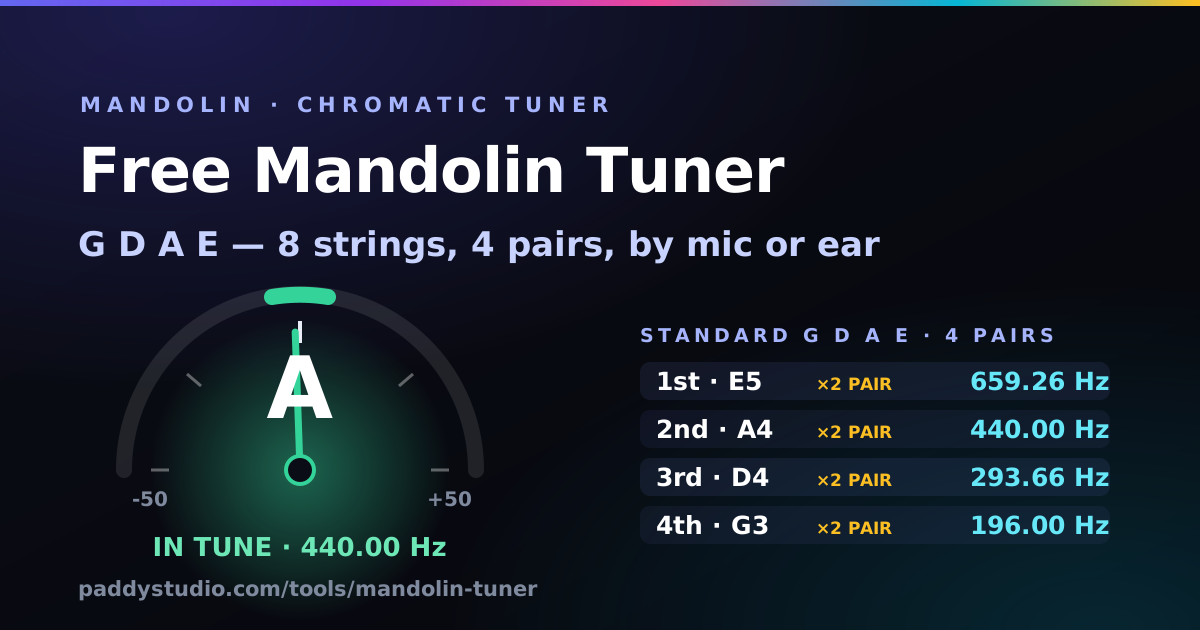
- Standard mandolin tuning is G D A E: G3 196.00 Hz, D4 293.66 Hz, A4 440.00 Hz and E5 659.26 Hz, lowest pair to highest. Same notes as a violin.
- Eight strings, four notes. The strings come in pairs (courses), and both strings in a pair are tuned to the same note.
- Tune one string at a time. Rest a finger on its partner so the tuner hears a single clean note.
- A wobbly “chorus” sound means a pair isn’t in unison. When both strings agree, the note goes steady.
- Start with the A pair, then D, G and E, then go round once more: the floating bridge lets every pair nudge the others.
- No microphone? Tap a pad (or keys 1–4) for a plucked reference tone and tune by ear.
How do I tune a mandolin with this tuner?
Tune each of the eight strings on its own, then check each pair plays as one note. Here’s the routine:
- Press “Start microphone” and say yes to the browser prompt. The audio is analysed on your device and goes nowhere else.
- Leave the reference at A4 = 440 unless your band or session tunes elsewhere.
- Mute one string of the A pair with a fingertip and pluck the other. Turn its key the way the tuner says: “tighten” if flat, “loosen” if sharp.
- Swap over and tune its partner to the same reading. Then pluck both together. Steady note? Good. Slow wobble? One of them is a hair out.
- Do the D, G and E pairs the same way. The pad gets a tick once a string holds the green zone.
- Go round all four pairs again, then press “Play all four” and listen to neighbouring pairs as fifths.
Pluck gently, close to the mic. A soft pick stroke near the soundhole gives the cleanest reading. Hammering the string makes it go sharp for the first split second, so let the note settle before you believe the needle. Everyone does this. I still do this.
What are the mandolin string notes and frequencies?
Standard mandolin tuning is G3, D4, A4, E5, from the lowest (thickest) pair to the highest. Each pair is a perfect fifth (seven semitones) above the one below, exactly like a violin. Players count the pairs from the floor up, so the E pair is the 1st course and the G pair is the 4th.
| Course | Note | Frequency | What it does |
|---|---|---|---|
| 4th (lowest pair) | G3 | 196.00 Hz | Wound strings; the low growl in a chop chord |
| 3rd | D4 | 293.66 Hz | Wound strings; lots of melodies start here |
| 2nd | A4 | 440.00 Hz | Plain steel; the reference pair, so tune it first |
| 1st (highest pair) | E5 | 659.26 Hz | Plain steel, very thin; the sparkle on top |
Why does a mandolin have eight strings?
Because the strings come in four pairs, called courses, and each pair is played as a single note. Your pick hits both strings at once, and your finger frets both at once. Doubling up makes the mandolin louder and gives it that bright, shimmering ring. Eight strings, twice the tuning, twice the fun. Mostly twice the tuning.
- Both strings of a pair must be in unison: the same note, not an octave apart. (Some twelve-string guitars use octave pairs. Mandolins don’t.)
- The chorus wobble is the giveaway. If a pair sounds like a slow “wah-wah-wah” or a cheap chorus pedal, the two strings disagree. The slower the wobble, the closer they are. Turn one until it stops.
- Why the pads say “pair”: this tuner has four pads, one per course. Tune both strings of a course to the same pad.
- Mute the partner while you tune. Two strings ringing slightly apart confuse any tuner, including the one in your head.
Where should the floating bridge sit?
The bridge should sit where the note at the 12th fret is exactly one octave above the open string. On most mandolins the bridge isn’t glued down; string pressure alone holds it, so it can creep when you change strings or knock the case.
- Switch the tuner to Chromatic mode.
- Play the 12th-fret harmonic of a pair (touch the string lightly right over the 12th fret wire, pluck, let go). Note the reading.
- Now fret the same string at the 12th fret and pluck it.
- If the fretted note reads sharp, nudge the bridge a millimetre or so towards the tailpiece. If it reads flat, nudge it towards the neck. Check the outer pairs, G and E, first.
Change strings one at a time. Take all eight off at once and the bridge falls over, and you get to rediscover where it lived. Ask me how I know. (I borrowed a friend’s mandolin. It went home with the bridge in a slightly different postcode.) Slacken the strings a little before you slide the bridge, and keep its feet flat on the top.
How do I check the fifths by ear?
Play two neighbouring pairs together, G with D, D with A, A with E, and listen for a smooth, still sound. In-tune fifths blend. A slow beating means one pair is slightly out, and the faster it beats, the further it is. Press “Play all four” to hear what the four open courses should sound like in a row.
There is a second check you get free on a mandolin: the 7th fret of each pair should match the open pair above it. 7th fret of the G pair equals open D, 7th fret of D equals open A, 7th fret of A equals open E. Frets make that a lot easier than it is on a violin.
What are the other mandolin tunings?
Standard G D A E covers bluegrass, Irish, classical and nearly everything else. Old-time players use a few cross tunings, and the bigger members of the family have their own. Choosing a tuning updates the pads, the reference tones and the target frequencies.
| Tuning | Notes (low → high) | Frequencies (Hz) | Used for |
|---|---|---|---|
| Standard | G3 D4 A4 E5 | 196.00 · 293.66 · 440.00 · 659.26 | Bluegrass, Irish, classical, pop |
| Cross tuning (AEAE) | A3 E4 A4 E5 | 220.00 · 329.63 · 440.00 · 659.26 | Old-time tunes in A with ringing open strings |
| A D A E | A3 D4 A4 E5 | 220.00 · 293.66 · 440.00 · 659.26 | Old-time tunes in D and A |
| G D G D | G3 D4 G4 D5 | 196.00 · 293.66 · 392.00 · 587.33 | Tunes in G and D, drone-heavy playing |
| Mandola | C3 G3 D4 A4 | 130.81 · 196.00 · 293.66 · 440.00 | The mandola: a fifth lower, like a viola |
| Octave mandolin | G2 D3 A3 E4 | 98.00 · 146.83 · 220.00 · 329.63 | Octave mandolin (Irish “octave mandola”): an octave below |
The last two are for the mandolin’s bigger siblings, with longer necks and heavier strings. Don’t try to tune an ordinary mandolin down to them: the strings go floppy and buzz. And going the other way, cross tunings raise some pairs, so bring them up gently and give the instrument a few minutes to settle before you retune.
Why I built this
I'm a guitarist: a Cort, a lot of enthusiasm, roughly twelve notes. Six strings already keep me busy. Then a mate turned up to a garden jam with a mandolin, handed it over “for a go”, and I spent the next ten minutes tuning eight strings that all seemed to have opinions. By the time I’d finished, everyone else had moved on to the next song. And the one after that.
So I took the engine from my guitar tuner and set it up for a mandolin: four pads for four pairs, a search range up to the high E, a brighter plucked tone, and tips for getting each pair into unison. I still can’t play the mandolin. But I can now tune one before the song ends, which my mate says is progress.
How do I use a mandolin in a Suno prompt?
Describe how the mandolin is played, not just that it’s there. “Mandolin” on its own tends to vanish into the mix. “Bright mandolin tremolo” or “mandolin chop on the backbeat” gives Suno something it can actually hear in its head. Here’s a starting style to paste in:
Modern bluegrass folk, 112 BPM, bright mandolin tremolo lead, mandolin chop on the backbeat, acoustic guitar, upright bass, warm male vocals with harmony, joyful, rustic, front-porch warmth
Playing a real mandolin over an AI track? Tune to the track first. If the song is a little off 440 Hz, nudge the A4 control until a reference tone matches the record, then tune all eight strings to that. The BPM and key finder tells you what key you’re in, and the tempo changer slows a fast reel down without changing its pitch.
How does the detection work, and what happens to my audio?
The tuner filters the microphone signal to cut rumble and the fizz of pick noise, then runs a YIN pitch detector. YIN compares the waveform with delayed copies of itself to find the period that repeats, then interpolates between samples to land within about a cent. A short median filter discards odd readings, and a fundamental check stops it jumping an octave when a low octave-mandolin string is quiet on a phone mic. In Mandolin mode it snaps to the nearest open course; Chromatic mode names any note from about 90 Hz to 1400 Hz, which is what you want for the bridge check.
The reference tones are synthesised on the spot with a plucked-string model (Karplus-Strong), voiced bright like steel strings. It all runs in the browser with the Web Audio API. Nothing is recorded, stored or sent anywhere, there’s no account, and pressing “Stop microphone” or closing the tab releases the mic straight away. Your tuning choice and A4 setting are saved in your browser’s local storage, on your device only.
Mandolin tuning FAQ
What are the notes on a mandolin?
G D A E, the same as a violin. From the lowest pair to the highest: G3 at 196.00 Hz, D4 at 293.66 Hz, A4 at 440.00 Hz and E5 at 659.26 Hz, at a reference pitch of A4 = 440 Hz. Both strings in each pair are tuned to the same note.
Why does a mandolin have eight strings?
The eight strings are arranged in four pairs, called courses. You fret and pick both strings of a pair together, so they must be tuned to exactly the same note. Doubling the strings makes the mandolin louder and gives it its shimmering, ringing sound.
How do I tune both strings in a pair?
Tune one string at a time. Rest a finger on one string of the pair, pluck the other and tune it with the needle, then swap. Finally pluck both together: a steady note means they are in unison, and a slow wobble means one of them still needs a nudge.
Which mandolin string should I tune first?
Start with the A pair, the 2nd course. It matches the A4 = 440 Hz reference, and once it is right you can tune the D, G and E pairs and check each one against its neighbour as a perfect fifth.
Is mandolin tuning the same as violin tuning?
Yes. Both are tuned G D A E in fifths, at exactly the same pitches, so fiddle tunes and violin fingerings carry straight over. The differences are that a mandolin has frets and doubled strings, and you play it with a pick instead of a bow.
What is cross tuning on a mandolin?
Cross tuning is A E A E: the G pair goes up to A3 and the D pair up to E4, while the A and E pairs stay put. The open strings then ring in A, which suits old-time tunes. A D A E and G D G D are the other common alternate tunings, and all three are in the tuning menu.
How do I tune a mandola or an octave mandolin?
Pick it in the tuning menu. A mandola is tuned C G D A (C3 130.81 Hz, G3 196.00 Hz, D4 293.66 Hz, A4 440.00 Hz), a fifth below the mandolin. An octave mandolin is G D A E one octave below the mandolin (G2 98.00 Hz, D3 146.83 Hz, A3 220.00 Hz, E4 329.63 Hz).
Why won’t my mandolin stay in tune?
New strings stretch for a few days, temperature and humidity move the pitch, and the floating bridge can creep if it gets knocked. Check the bridge is still in the right place, retune, and expect to touch it up a couple of times while new strings settle.
Can I tune a mandolin without a microphone?
Yes. Tap any of the four course pads, or press keys 1 to 4, to hear a plucked reference tone, then match each string of the pair to it by ear.
Is my microphone audio recorded or uploaded?
No. The pitch detection runs inside your browser using the Web Audio API. Nothing is recorded, stored or sent to a server.
Got a mandolin part in your head?
The free Paddy Prompt Studio builds Suno style prompts and Vidmuse video scripts. Pick a genre, mood and vocal and it writes the style line for you, tremolo and all.
Open the Prompt Studio →