
The short version
- Rough voice-type ranges: bass about E2–E4, baritone A2–A4, tenor C3–C5, countertenor E3–E5, contralto F3–F5, mezzo-soprano A3–A5 and soprano C4–C6. These are textbook outlines; real voices overlap.
- Your vocal range is the distance from the lowest to the highest note you can sing clearly and hold, usually written as two note names and a number of octaves, such as A2–E4 (1.6 octaves).
- A common rule of thumb is that an untrained adult can comfortably sing about one and a half to two octaves. There is no official average, so treat that as a guide.
- Voice type is not just range. Timbre, tessitura (where your voice sits comfortably) and where it changes register matter as much, which is why a range test can only give a rough match.
- To pick a song key, keep the melody inside your comfortable middle and move the key until the highest melody note sits a little below your comfortable top.
- Never force the edges. Warm up, sip water, and stop if anything hurts or feels scratchy. A note you can only squeeze out once is not part of your usable range.
How to use the vocal range test
- Press “Start the test” and allow the microphone. Sit about an arm’s length from it in a quiet room. Nothing is recorded or uploaded.
- Warm up with a hum. A lazy “mmm” near your speaking pitch, sliding around a little. It proves the mic can hear you and wakes the voice up.
- Slide down to your lowest comfortable note and hold it on “ah” or “mm”. The hold bar fills over about half a second; when it turns green the note counts. Creaky fry and growls do not.
- Slide up to your highest comfortable note and hold it. Stop before it strains. Tick “Include falsetto / head voice” first if you want a bonus step for your lighter top notes.
- Read your result: your range, the closest voice types with an overlap score, your comfortable middle and a key hint. Copy the share line, or the Suno snippet, or open it straight in the Prompt Studio.
Not sure where to start? Use “Play note” (or click any row on the ladder) to hear a reference pitch, then hum it back. A3 is a comfortable middle for a lot of adult voices; lower voices may prefer starting around A2. Prefer to noodle? Switch to Just sing mode and sing anything: the lowest and highest held notes are kept.
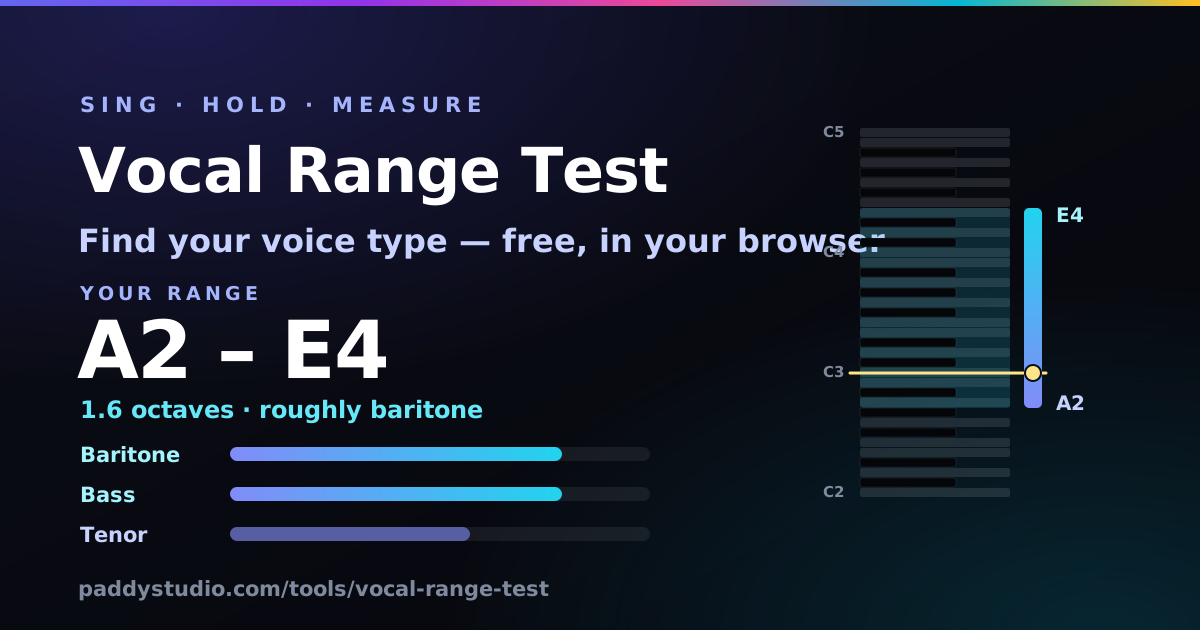
What are the vocal ranges for each voice type?
Each voice type has a rough textbook range, about two octaves wide. These are the outlines used in classical singing; pop singers, choirs and voice teachers all draw the edges slightly differently, and plenty of healthy voices sit between two types.
| Voice type | Rough range | Frequencies | Usually |
|---|---|---|---|
| Bass | E2 – E4 | 82.4 – 329.6 Hz | Lowest male voice |
| Baritone | A2 – A4 | 110.0 – 440.0 Hz | The most common male voice |
| Tenor | C3 – C5 | 130.8 – 523.3 Hz | Higher male voice |
| Countertenor | E3 – E5 | 164.8 – 659.3 Hz | Male voice singing mainly in head voice / falsetto |
| Contralto / Alto | F3 – F5 | 174.6 – 698.5 Hz | Lowest female voice |
| Mezzo-soprano | A3 – A5 | 220.0 – 880.0 Hz | Middle female voice |
| Soprano | C4 – C6 | 261.6 – 1046.5 Hz | Highest female voice |
Middle C is C4 (261.6 Hz). The number after the letter is the octave, and each octave starts on C, so B3 is directly below C4. “Alto” is the choir name; “contralto” is the classical solo name for roughly the same low female voice.
What is the average vocal range?
There is no official average vocal range. A common rule of thumb among voice teachers is that an untrained adult can comfortably sing roughly one and a half to two octaves, and trained singers often manage more. Your own number moves around with warm-up, sleep, illness and time of day, so test a few times and trust the comfortable result rather than the best-ever one.
How to find your vocal range safely
- Warm up first. Two or three minutes of humming, lip trills and gentle sirens. Cold voices read narrower, and forcing a cold voice is how you end up croaky.
- Hydrate. Sip room-temperature water before and between attempts.
- Count only comfortable notes. If the note needs a neck strain, a pushed chin or a shout, it is past your usable range — leave it out.
- Slide, don’t jump. Gliding slowly to each end is gentler and gives the detector a steady pitch to lock onto.
- Low notes need volume, not pressure. Get a bit closer to the mic rather than pushing the voice down.
- Stop if it hurts. Pain, a scratchy throat or hoarseness that lingers are signals to rest. If hoarseness lasts more than a couple of weeks, see a doctor.
This is a fun, rough measuring tool, not voice training or medical advice. A few extra semitones on a screen are never worth a sore throat.
Chest voice, head voice and falsetto: what’s the difference?
Your voice has different registers — ways the vocal folds vibrate that produce noticeably different sounds. Most people use three words for them, although teachers do not all agree on exactly where one ends and the next begins.
| Register | What it feels and sounds like | Where it sits |
|---|---|---|
| Chest voice | Your speaking voice. Full, strong, with a buzz you can feel in your chest. | Lower and middle notes |
| Head voice | Lighter and brighter, felt more in the face and head, but still clear and connected. | Upper notes |
| Falsetto | Airy, flutey and breathier, often with a noticeable “flip” on the way in. Most familiar in male voices. | Upper notes, often above the chest-voice top |
The spot where your voice wants to flip or crack is called the break or passaggio. Everyone has one. This test measures your chest range by default and treats falsetto as an optional bonus, so your voice-type match stays based on the voice you would actually sing most songs in.
Range vs tessitura: which matters more?
Tessitura is the part of your range where your voice sounds best and can sing for a whole song without tiring — usually the middle. Range is everything, edges included. For choosing songs, tessitura matters more: a song whose melody lives in your middle and only touches the edges for a big moment feels easy, while one that hammers your top note every chorus wears you out even if you can technically hit it. The result card shows a rough “comfy middle” for exactly this reason.
How do I pick a song key for my range?
Move the song’s key until its melody fits inside your comfortable middle, with the highest melody note sitting a little below your comfortable top. In practice:
- Find the melody’s highest and lowest notes. Hum them into this page in Just sing mode and it will name them for you.
- Compare with your result. Count the semitones between the melody’s top note and your comfortable top.
- Shift the key by that many semitones, then check the lowest melody note still sounds clear rather than mumbled.
Worked example: a song in G has a melody from G3 up to D5, and your comfortable top is A4. D5 down to A4 is five semitones, so drop the song five semitones from G to D. The melody now runs D3 to A4. On guitar, a capo raises the key; to lower it you change chord shapes (or tune down). The chord progression generator will lay out a progression in whichever key suits you.
Why I built this
I’m a guitarist. I can sing roughly enough to annoy the neighbours, and for years my method of choosing a key was “start the song, discover the chorus is too high, put a capo on, try again”. That is a lot of capo.
The honest bit: I didn’t actually know my range. I guessed “baritone, probably” because it sounded nice. So I built the thing I wanted — a test that only counts notes I can genuinely hold, not the one strangled squeak I managed once — and then pointed it at the problem I actually have, which is singing over my own Suno tracks without the melody running off without me. I won’t tell you what it said about me. Let’s just say my top end should not be attempted before coffee.
Using your vocal range in a Suno prompt
Suno sings with its own synthetic voices, so your range matters in two ways: picking a voice that matches yours (handy for demos you will re-sing yourself), and keeping the key somewhere you can follow. The result card turns your voice type into a vocal tag and a key hint, builds a style snippet you can copy, and the “Open in Prompt Studio” button pre-fills the vocal option in the Paddy Prompt Studio for you.
| Your rough voice type | Main vocal tag | Also try |
|---|---|---|
| Bass | Deep baritone male vocals | Raw emotional male vocals |
| Baritone | Deep baritone male vocals | Clean melodic male vocals |
| Tenor | Clean melodic male vocals | Raw emotional male vocals, Gritty melodic male vocals |
| Countertenor | Clean melodic male vocals (plus “airy male falsetto”) | Soaring operatic soprano harmonies |
| Contralto / Alto | Breathy intimate female vocals | Clean melodic female vocals, Powerful female belt vocals |
| Mezzo-soprano | Breathy intimate female vocals | Clean melodic female vocals, Powerful female belt vocals |
| Soprano | Soaring operatic soprano harmonies | Clean melodic female vocals, Sweet girl-group female harmonies |
Deep baritone male vocals, comfortable mid-range melody, key of D major
A caveat: Suno does not always obey a key written in the style prompt. It is still worth including, and if a generation comes back too high, regenerate or pick a lower vocal tag. For where vocal tags go and how they interact with song sections, see Suno song structure and vocal tags.
Tips for singing over your own Suno tracks
- Check the key before you rehearse. Run the track through the BPM & key finder, then hum the melody’s top note here and compare it with your comfy middle.
- Small pitch shifts sound cleaner than big ones. If the instrumental is a semitone or two out of your range, pitch-shifting it in your DAW usually works; bigger shifts tend to add audible artefacts, so regenerating in a better key is often the nicer fix.
- Leave yourself room to breathe. AI melodies can cram syllables. Check line lengths with the syllable counter and rewrite where you would run out of air — writing lyrics for Suno covers meter and stress.
- Record dry, on headphones, so the backing track doesn’t bleed into your vocal take. Effects go on afterwards.
- Warm up, and do the hard song last. Your range is wider twenty minutes in than in the first take.
How it works, and what it does with your audio
The microphone signal is band-limited, then a YIN pitch detector (the same one used in the guitar tuner, widened to roughly 60–1400 Hz for voices) compares the waveform with delayed copies of itself to find its repeating period about twenty times a second. A short median filter ignores single wild readings, such as octave flips.
On top of that is a held-note filter: a note only counts once readings have arrived continuously for about half a second and all stayed within roughly three-quarters of a semitone of each other. That allows gentle vibrato but rejects cracks, breaths, clicks, vocal fry and fast slides. The voice-type match compares your range with each type’s textbook range: 60% of the score is how much the two ranges overlap, 40% is how close their middles are.
All of it runs in your browser with the Web Audio API. No audio is recorded, stored or uploaded, there is no account, and pressing Stop or closing the tab releases the mic. The only thing saved is your last result — a few note names — in your browser’s local storage, so you can compare next time.
Vocal range FAQ
How do I find my vocal range?
Warm up, slide down to the lowest note you can sing clearly and hold it, then slide up to the highest note you can hold without straining. The distance between them is your range. This page does it with your mic, counting a note only once you have held it steadily for about half a second.
What is the average vocal range?
There is no official average. A common rule of thumb is that an untrained adult can comfortably sing roughly one and a half to two octaves, and trained singers often cover more. It varies with warm-up, health and time of day, so treat any single number as a rough guide.
Is an online vocal range test accurate?
The note detection is: in a quiet room it reads within a few cents. The weak points are the microphone and the singer. Small laptop and phone mics can struggle with very low notes, and a cold or forced range is not your real usable one. Warm up first and count only comfortable notes.
Does my range decide my voice type?
Only partly. Voice teachers also listen to timbre, tessitura and where your voice changes register, which is why two people with the same range can be a baritone and a tenor. The match here is a rough, range-only guide.
Does falsetto count as part of my range?
It counts towards your total range but is usually listed separately because it is a different, lighter sound. This test measures chest voice by default; tick “Include falsetto / head voice” for a bonus step. The voice-type match always uses the chest-voice range.
What is the difference between range and tessitura?
Range is everything from lowest to highest note. Tessitura is the narrower zone where your voice sounds best and can sing a whole song without tiring, usually the middle. Songs feel easy when the melody lives in your tessitura.
How do I choose the right key for my voice?
Find the melody’s highest and lowest notes, then move the key by however many semitones it takes to put the highest note a little below your comfortable top. Check the lowest note still sounds clear. On guitar, a capo does the same job for raising the key.
Can I increase my vocal range?
Usually a little, with regular practice: warm-ups, gentle sirens and good breath support often add a few comfortable notes, mostly at the top. Results vary. Never push through pain or hoarseness, and see a voice teacher or doctor if your voice hurts or stays hoarse.
Why does it not pick up my lowest notes?
Very low notes are quiet, and many built-in mics roll off the bass. Move a little closer, sing on an open “ah” rather than a whisper, and hold the note steady for a second. Creaky vocal fry is ignored on purpose because its pitch is not stable.
Is my singing recorded or uploaded?
No. Detection runs entirely in your browser; nothing is recorded and no audio reaches any server. Only your last result — a few note names — is kept in your browser’s local storage.
Got your range? Make a song that fits it
The free Paddy Prompt Studio builds Suno style prompts — genre, mood, instruments and a vocal style that matches your voice type — so the AI demo lands somewhere you can actually sing.
Open the Prompt Studio →