
The short version
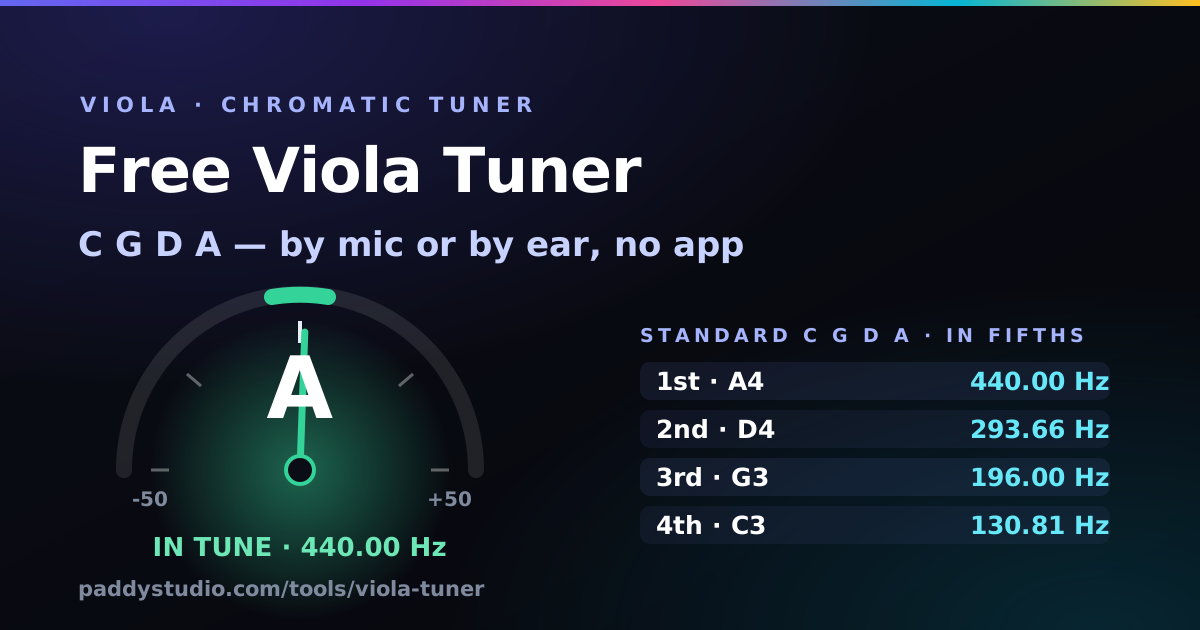
- Standard viola tuning is C G D A: C3 130.81 Hz, G3 196.00 Hz, D4 293.66 Hz and A4 440.00 Hz, from the lowest string to the highest.
- It is a violin’s tuning a fifth lower, minus the E string, plus a low C.
- Tune the A string first, then D, G and C.
- The strings are a perfect fifth apart. Play two neighbours together: in tune, they sound smooth with no wobble.
- The cello uses the same notes, one octave lower. Use the cello tuner for that.
- No microphone? Tap a string pad (or keys 1–4) for a pizzicato reference tone and tune by ear.
How to tune a viola with this tuner
- Press “Start microphone” and accept the browser prompt. Audio is analysed on your device; nothing is recorded or uploaded.
- Check the reference pitch. 440 Hz is standard; many orchestras use 442. Press + to match.
- Bow or pluck the A string on its own. A long, steady bow gives the steadiest reading.
- Turn the fine tuner or peg the way the tuner says. The pad gets a tick once you hold inside five cents.
- Work down: D, G, then C. The C string takes a moment longer to read, so let it ring.
- Go round all four again and press “Play all four” to hear the fifths.
Low C reading slowly? Small laptop and phone mics pick up low notes weakly. Hold the viola a little closer to the mic and bow firmly. If the needle still wanders, pluck the string and let it ring; the tuner is listening for the fundamental, not the scratch.
What are the viola string notes and frequencies?
Standard viola tuning is C3, G3, D4, A4, from the lowest (thickest) string to the highest. The A string is the 1st string and the C string is the 4th. Like the violin, each string is a perfect fifth above the one below. Viola music is written mostly in alto clef, where middle C sits on the middle line.
| String | Note | Frequency | What it does |
|---|---|---|---|
| 4th (lowest) | C3 | 130.81 Hz | The deep, dark string that gives the viola its voice |
| 3rd | G3 | 196.00 Hz | Shared with the violin’s lowest string |
| 2nd | D4 | 293.66 Hz | The middle voice |
| 1st (highest) | A4 | 440.00 Hz | The tuning reference: tune this one first |
Viola vs violin tuning: what’s the difference?
The viola is tuned a perfect fifth below the violin. The two instruments share three strings, G, D and A, but the violin has an E on top and the viola has a C at the bottom. That low C string is where the viola gets its rich, slightly melancholy sound, and why it often gets the inner harmony in an orchestra.
| Instrument | Open strings | Intervals | Lowest note |
|---|---|---|---|
| Violin | G3 D4 A4 E5 | Fifths | 196.00 Hz |
| Viola | C3 G3 D4 A4 | Fifths | 130.81 Hz |
| Cello | C2 G2 D3 A3 | Fifths | 65.41 Hz |
| Double bass | E1 A1 D2 G2 | Fourths | 41.20 Hz |
Pegs or fine tuners?
Fine tuners for small changes, pegs for big ones. Many violas only have a fine tuner on the A string, which is normal. When you use a peg, loosen it slightly, then bring the string up to pitch while pushing the peg gently into the pegbox so it holds. If a fine tuner has run out of thread, unscrew it to the middle and make up the difference with the peg.
Keep an eye on the bridge. Tuning up pulls the top of the bridge towards the fingerboard. If it starts to lean, ease it back upright or ask your teacher. A fallen bridge is a bad day for everyone, including the soundpost.
How to check the fifths by ear
Once the needle says each string is in tune, play pairs together: C with G, G with D, D with A. A pure fifth sounds still and smooth. If you hear a slow “wah-wah” beating, one string is slightly out; the faster the beating, the further off it is. Adjust until the wobble disappears.
Viola tuning chart
Standard C G D A covers nearly every piece you will ever play. The scordatura is there for one very famous exception.
| Tuning | Notes (low → high) | Frequencies (Hz) | Used for |
|---|---|---|---|
| Standard | C3 G3 D4 A4 | 130.81 · 196.00 · 293.66 · 440.00 | Everything: orchestral, chamber, solo, folk |
| Mozart K. 364 scordatura | C♯3 G♯3 D♯4 A♯4 | 138.59 · 207.65 · 311.13 · 466.16 | Mozart’s Sinfonia Concertante K. 364 (solo viola) |
Mozart wrote the solo viola part of his Sinfonia Concertante in D major and asked the violist to tune every string up a half step, so the part could be read in D while it sounded in E♭. The higher tension makes the viola brighter, so it can hold its own next to the solo violin. These days most violists play it in normal tuning, but if you want to try the original, the preset is in the menu. Go gently: that is a lot of extra tension.
Why I built this
I'm a guitarist: a Cort, a lot of enthusiasm, roughly twelve notes. I have never played the viola, so I'll stay out of the viola jokes; violists have heard them all, usually from violinists. What I do know is that every orchestra needs violists, and every violist needs a tuner that can read that low C without the needle wandering.
So I took the engine behind my guitar tuner, set it up for the viola’s range, and gave it pizzicato reference tones for tuning by ear, plus a button that plays the four strings in a row so you can hear the fifths. It’s small, it’s free, and it doesn’t want your email address.
Using a viola in a Suno prompt
The viola is the secret ingredient in a lot of cinematic string arrangements. In Suno, ask for it by name and say what it is doing. “Warm viola countermelody” or “viola and cello harmonies” works much better than just “strings”. Here is a starting style to paste in:
Neo-classical chamber pop, 84 BPM, warm viola countermelody, cello harmonies, felt piano, soft brushed drums, breathy male vocals, melancholic, intimate, cinematic
Recording a real viola over an AI track? Tune to the track first: if it sits a little off 440 Hz, nudge the A4 control until a reference tone matches the record. The BPM and key finder tells you the key.
How the detection works, and what it does with your audio
The tuner filters the microphone signal so rumble and bow noise can’t fool the maths, then runs a YIN pitch detector. It compares the waveform with delayed copies of itself to find the period that repeats, and interpolates between samples to land within about a cent. A “prefer fundamental” check stops it locking onto the strong overtones of the C string, and a short median filter keeps the needle steady through a bit of vibrato. In Viola mode it snaps to the nearest open string; Chromatic mode names any note from about 105 Hz to 1100 Hz.
The reference tones are synthesised on the spot with a plucked-string model (Karplus-Strong), so they sound like a pizzicato note rather than a test beep. All of it runs in the browser with the Web Audio API. No audio is recorded, stored or sent anywhere, there's no account, and pressing “Stop microphone” or closing the tab releases the mic immediately. Your tuning choice and A4 setting are saved in your browser's local storage, on your device only.
Viola tuning FAQ
What are the notes on a viola?
C G D A. From the lowest string to the highest: C3 at 130.81 Hz, G3 at 196.00 Hz, D4 at 293.66 Hz and A4 at 440.00 Hz, at a reference pitch of A4 = 440 Hz.
How is a viola tuned compared to a violin?
A perfect fifth lower. Both share G, D and A strings, but the viola has a low C string instead of the violin’s high E.
Which viola string should I tune first?
The A string. Then tune D, G and C, either with the tuner or by listening for smooth fifths between neighbouring strings.
Is the viola tuned the same as a cello?
It uses the same note names, C G D A, but the cello is one octave lower: C2, G2, D3, A3. Use the cello tuner for a cello.
Why is the C string hard to tune with my phone?
Small phone and laptop mics pick up low notes weakly. Get closer, bow firmly, or pluck the string and let it ring. The tuner also has a fundamental check that avoids locking onto overtones.
Should I tune with the pegs or the fine tuners?
Use fine tuners for small changes and pegs for big ones. When turning a peg, push it gently inwards so it holds.
Should I tune to 440 or 442 Hz?
A4 = 440 Hz is standard. Many orchestras tune to 442 Hz. Use the + and − buttons next to “A4 = 440” to match.
Can I tune a viola without a microphone?
Yes. Tap a string pad, or press keys 1 to 4, to hear a pizzicato reference tone and match it by ear.
Is my microphone audio recorded or uploaded?
No. Pitch detection runs in your browser with the Web Audio API. Nothing is recorded and no audio is sent to any server.
Arranging strings for a song?
The free Paddy Prompt Studio builds Suno style prompts and Vidmuse video scripts. Pick a genre, mood and vocal and it writes the style line for you.
Open the Prompt Studio →