
The short version
- Arabic oud is usually C2 F2 A2 D3 G3 C4; Turkish oud is the same shape a whole step up, C♯2 F♯2 B2 E3 A3 D4.
- Bağlama in bozuk düzen is written La–Re–Sol (alt, orta, üst) and, on a long neck at Do karar, sounds C–F–B♭.
- A kharaj-pancham sitar is Ma Sa Pa Sa Pa Sa Sa. Tune Pa and Ma pure against Sa, not to the piano.
- The open strings are the easy part. The microtones happen under your fingers. Switch to Free mode and pick 24-TET, 53 komas or shrutis to check them.
- Harmonics making it jump? Tap the pad for that string to lock on. Octave mistakes get ignored.
Why I built a tuner for instruments I don’t play
Fair question. I’m a guitarist: a Cort, a lot of enthusiasm, roughly twelve notes. But the guitar tuner on this site keeps getting emails along the lines of “lovely, but it calls my sikah an out-of-tune E.” And it’s right to. A normal tuner only knows the twelve piano notes, so anything between them gets marked as a mistake.
Here’s the honest bit. For the open strings, a normal tuner is mostly fine. Arabic and Turkish oud courses, bağlama courses and a sitar’s Sa all land on ordinary Western pitches (the sitar’s Pa and Ma land a couple of cents off them). Where generic tuners fall over is everything that happens after that: the half-flat third of maqam Rast, the one-koma-flat Segâh of Turkish makam, the komal Re of Bhairav. That’s what this tuner is for. It does the boring open-string bit too, and then it actually understands the notes in between.
I checked every preset against players’ own sources rather than making it up. If your tradition does something differently, and it probably does somewhere, tell me and I’ll fix it.
How to use it
- Pick your instrument. The pads change to every course, bam strings and chikaris included, each with its frequency.
- Set the pitch. The first stepper moves the whole instrument. On a sitar it’s your Sa; on a bağlama it’s the note your alt tel sounds (your karar). A4 stays at 440 unless you’re matching someone else.
- Start the microphone and play one open course. The needle shows the cents; tighten if flat, loosen if sharp. Each pad gets a tick once it’s held in the green.
- Tap a pad to hear it and lock the tuner onto it. Very handy on a sitar, where the jawari buzz makes harmonics louder than the note.
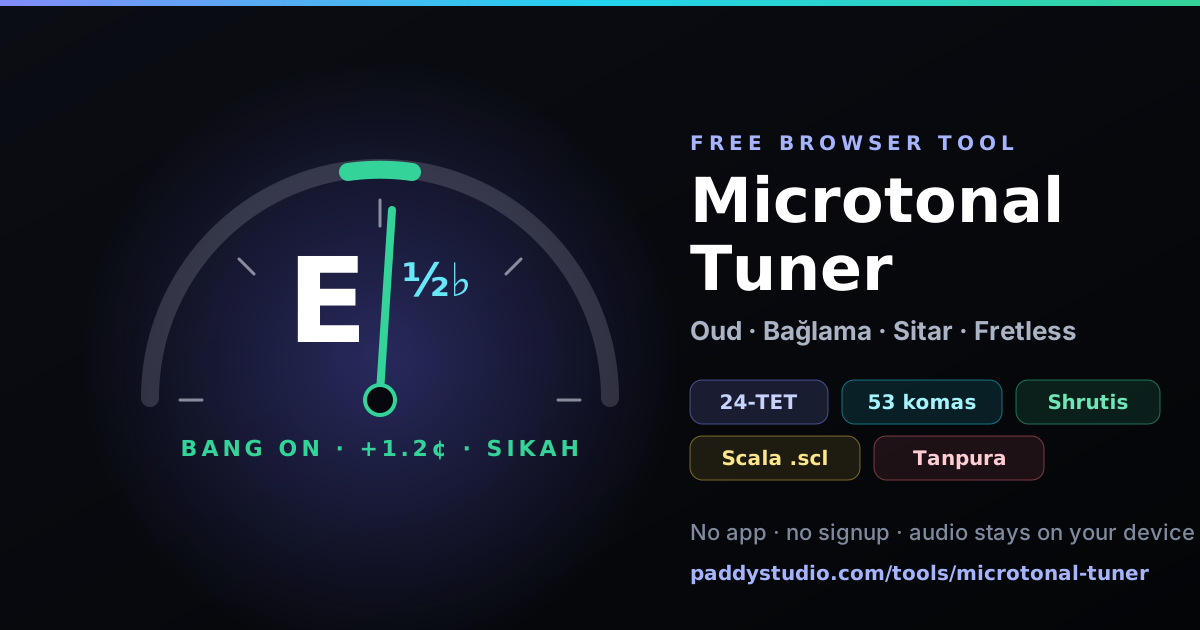
- Switch to Free mode and choose a system. Now every note you play gets named: E½♭, B −1 koma, komal Re at 16:15, or degree 5 of your own Scala scale.
- Turn on the drone and practise holding notes. The pitch trail shows where you wandered off, and the hold timer shows how long you stayed in the green. Beat your best.
Straight to a setup: Arabic oud + quarter-tones · Turkish oud + 53 komas · Bağlama, bozuk düzen · Sitar + 22 shrutis on C♯
Oud tuning: Arabic and Turkish
The top four courses are always in fourths. The two bass courses are where players disagree, sometimes per maqam. Turkish tuning is the Arabic shape one whole step higher. Don’t crank an Arabic oud up to Turkish pitch. The extra tension can lift the bridge. Going down is safe.
| Tuning | Notes (6th → 1st) | Frequencies (Hz) |
|---|---|---|
| Arabic (most common) | C2 F2 A2 D3 G3 C4 | 65.41 · 87.31 · 110.00 · 146.83 · 196.00 · 261.63 |
| Arabic, alternative | D2 G2 A2 D3 G3 C4 | 73.42 · 98.00 · 110.00 · 146.83 · 196.00 · 261.63 |
| Turkish (most common) | C♯2 F♯2 B2 E3 A3 D4 | 69.30 · 92.50 · 123.47 · 164.81 · 220.00 · 293.66 |
| Turkish, modern alternative | D2 A2 B2 E3 A3 D4 | 73.42 · 110.00 · 123.47 · 164.81 · 220.00 · 293.66 |
Charts online often list these high to low (D–A–E–B–F♯–C♯), which is why half of them seem to contradict the other half. They don’t. They’re just reading the oud from the other end.
Bağlama (saz) tuning: bozuk düzen and bağlama düzeni
Bağlama is written as a transposing instrument: the names players use (La, Re, Sol) aren’t the notes a tuner hears. The pads show both. The written name sits on top and the sounding note sits underneath. The values below are for the common “Do karar” setup on a 38–42 cm tekne. If your karar is different, use the first stepper and every course moves together.
| Neck · düzen | Written | Alt (+bam) | Orta | Üst (+bam) |
|---|---|---|---|---|
| Uzun sap · bozuk | La · Re · Sol | C4 261.63 (C3 130.81) | F3 174.61 | B♭3 233.08 (B♭2 116.54) |
| Uzun sap · bağlama düzeni | Re · Sol · La | C4 261.63 (C3 130.81) | F3 174.61 | G3 196.00 (G2 98.00) |
| Kısa sap · bozuk | La · Re · Sol | F4 349.23 (F3 174.61) | B♭3 233.08 | E♭4 311.13 (E♭3 155.56) |
| Kısa sap · bağlama düzeni | Re · Sol · La | F4 349.23 (F3 174.61) | B♭3 233.08 | C4 261.63 (C3 130.81) |
Some teachers write bağlama düzeni as La–Re–Mi instead. Same tuning, different reference note. The intervals are identical, so the tuner doesn’t care what you call it.
The microtonal frets on a bağlama are moveable. If your open strings read perfect but Segâh sounds wrong, it’s the perde (fret) position, not the tuning. Switch to Free mode with 53 komas, fret the note, and nudge the perde until the reading says B −1k (or wherever your makam wants it).
Sitar tuning (kharaj-pancham)
This is the seven-string Ravi Shankar / Maihar setup. Sa usually sits somewhere between C and D, very often C♯, which is the default here. Pick yours with the Sa control. The pads list strings in peg order.
| String | Swara | Note | Hz (pure) |
|---|---|---|---|
| 1 · Baaj (main playing string) | Ma | F♯3 | 184.79 |
| 2 · Jod | Sa | C♯3 | 138.59 |
| 3 · Pancham | Pa | G♯2 | 103.94 |
| 4 · Kharaj | Sa | C♯2 | 69.30 |
| 5 · Pa chikari | Pa | G♯3 | 207.89 |
| 6 · Chikari | Sa | C♯4 | 277.18 |
| 7 · Chikari | Sa′ | C♯5 | 554.37 |
Notice the Pa strings read 103.94 Hz, not the piano’s 103.83. That’s the pure 3:2 fifth, about two cents sharp of equal temperament. Small, but it’s the difference between a sitar that rings and one that just sort of hums politely. The Pancham string also changes with the raga (Malkauns wants Ma instead), and the taraf strings get retuned for every raga, so use Free mode with Just intonation or 22 shrutis for those.
The tuning systems, in plain English
| System | Steps per octave | Good for |
|---|---|---|
| 24-TET (quarter-tones) | 24 × 50¢ | Arabic maqam notation, quarter-tone guitar, Persian-ish sketches |
| 53 komas (AEU) | 53 × 22.64¢ | Turkish makam, setting bağlama perdes |
| Just intonation, 12 swaras | 12, pure ratios from Sa | Hindustani practice with a tanpura, barbershop, anyone tuning by beats |
| 22 shrutis | 22, pure ratios from Sa | Fine raga intonation, like the low, swaying komal Ga of Darbari Kanada |
| 12-TET | 12 × 100¢ | Plain chromatic, same as a normal tuner |
| ¼-comma meantone | 12, unequal | Renaissance and early Baroque keyboards, sweet major thirds |
| Werckmeister III | 12, unequal | Bach-era well temperament on harpsichord and organ |
| Custom Scala (.scl) | Whatever you load | Xenharmonic guitars, 19-EDO, Bohlen-Pierce, your teacher’s exact maqam |
Arabic quarter-tones and maqam note names
In 24-TET mode the readout prints half-flats as ½♭ and half-sharps as ½♯, with the Arabic name underneath where there is one. Here’s maqam Rast on C, the scale most people meet first:
| Degree | Note | Arabic name | Cents above C |
|---|---|---|---|
| 1 | C | Rast | 0 |
| 2 | D | Dukah | 200 |
| 3 | E½♭ | Sikah | 350 |
| 4 | F | Jaharkah | 500 |
| 5 | G | Nawa | 700 |
| 6 | A | Husayni | 900 |
| 7 | B½♭ | Awj | 1050 |
One caveat I’d be daft not to mention: 24-TET is a notation grid, not the gospel. Sikah in Cairo, Aleppo and Baghdad is played a few cents apart, and it moves within a phrase. Use the reading as a reference point and let your teacher’s ear win any argument. If you want a specific school, load it as a Scala file. The example button loads a just-intonation Rast with sikah at 27:22 (about 355¢) and awj at 11:6 (about 1049¢).
Turkish komas and AEU accidentals
Turkish makam theory splits the octave into 53 Holdrian commas, or komas, of about 22.64 cents each, and a whole tone is nine of them. In 53 komas mode the tuner shows the nearest natural plus or minus some komas (for example B −1k), and gives the other spelling too. Eviç shows as G −1k and “also F büyük mücennep sharp”.
| Accidental | Komas | ≈ Cents | Example |
|---|---|---|---|
| Koma | 1 | 22.6 | Segâh = B −1 koma |
| Bakiye | 4 | 90.6 | F♯ in makam terms = F +4 |
| Küçük mücennep | 5 | 113.2 | G♭ = G −5 |
| Büyük mücennep | 8 | 181.1 | Eviç = F +8 |
| Tanini (whole tone) | 9 | 203.8 | C to D |
Swaras and shrutis
In the two Indian systems the readout uses the usual shorthand: lower case means komal (re, ga, dha, ni) or shuddha ma, and capitals mean shuddha (Re, Ga, Dha, Ni) or tivra Ma. The little number is the ratio against your Sa. In 22-shruti mode, a few swaras appear twice, for example Re at 10:9 and at 9:8. That’s the point of shrutis. The names and exact ratios vary between texts, so think of this as one common modern reading, not the final word.
Practising intonation (and the game)
Tuning takes a minute. Intonation takes years. The two practice tools are for the years bit:
- Drone. The tanpura plucks Pa–Sa–Sa–low Sa in a loop with a bit of synthetic jawari buzz. Swap Pa for Ma or Ni depending on the raga. For maqam or makam, the steady drone holds your tonic and a pure fifth. It follows the Tonic / Sa setting.
- Pitch trail and hold timer. Hold a note and watch the line. Wobbling through the green is vibrato. Sliding out of it slowly is a tired hand. Your best hold time is saved, and I’m told it is an excellent way to waste an evening.
- Microtone hunt. The tuner names a microtone in your current system: E½♭, G −1k, komal Re. You find it on your instrument (or sing it) and hold it. You get “warmer/colder” hints in cents as you go. Press Hear it if you’re stuck. Streaks reset if you skip, because I’m not a monster, but I am fair.
How it works, and what it does with your audio
Under the bonnet it’s the same detector as my guitar tuner. A YIN pitch detector runs on a band-limited copy of the mic signal, finds the repeating period and interpolates to roughly one cent, with a median filter to bin stray readings. The range is widened to 50–1100 Hz so a sitar’s kharaj Sa and a short-neck bağlama’s alt tel both fit. Each reading is then matched against the system you picked, so a koma-flat B is a perfectly good note and not “B, 23 cents flat, you fool.”
It all happens in your browser using the Web Audio API. No audio is recorded, stored or sent anywhere, there’s no account, and your settings, Scala scale and high scores live in your own browser’s storage. Close the tab and the mic is released.
Microtonal tuning FAQ
Can a normal guitar tuner tune an oud?
For the open strings, mostly yes. Arabic (C2 F2 A2 D3 G3 C4) and Turkish (C♯2 F♯2 B2 E3 A3 D4) oud tunings use ordinary Western pitches. Where it fails is the maqam notes you play with your fingers. A microtonal tuner calls sikah E half-flat instead of telling you your E is broken.
What is the standard tuning of an Arabic oud?
Most commonly C2 F2 A2 D3 G3 C4, low to high: 65.41, 87.31, 110.00, 146.83, 196.00 and 261.63 Hz at A4 = 440. D2 G2 A2 D3 G3 C4 is a common alternative. The top four courses are always in fourths.
What’s the difference between Turkish and Arabic oud tuning?
Same intervals, one whole step higher: C♯2 F♯2 B2 E3 A3 D4, or D2 A2 B2 E3 A3 D4. Don’t tune an Arabic oud up to Turkish pitch, because the extra tension can damage it. Tuning a Turkish oud down is fine.
How do I tune a bağlama in bozuk düzen?
Written La–Re–Sol from alt to üst. On a long neck at Do karar it sounds C4 (with a C3 bam), F3, and B♭3 (with a B♭2 bam). Pick Bağlama (uzun sap) — Bozuk düzen and the pads show both the written and sounding names.
How is a sitar tuned?
Kharaj-pancham style: Ma, Sa, Pa, Sa, Pa, Sa, Sa. With Sa at C♯ that’s F♯3, C♯3, G♯2, C♯2, G♯3, C♯4 and C♯5. Tune Pa and Ma pure (3:2 and 4:3), which is about two cents off the piano notes, and the tuner does exactly that.
What is a quarter-tone?
Half a semitone, 50 cents in 24-TET, the grid Arabic maqam is written on. E half-flat sits at 350¢ above C. Real-world sikah varies by region, so treat the grid as a map, not a rule.
What is a koma in Turkish music?
One fifty-third of an octave, about 22.64 cents. A whole tone is 9 komas, and the AEU accidentals move a note by 1, 4, 5 or 8 komas. Segâh is B lowered by one koma.
Can I load my own tuning or Scala file?
Yes. Pick Custom — import a Scala .scl file, then paste it or open it from your device. Ratios, cents and non-octave periods all work, and it’s saved in your browser, not uploaded.
Why does it jump an octave on sitar or bağlama?
The jawari bridge and the octave bam strings make some harmonics louder than the note itself, and that fools every pitch detector, not just this one. Tap the pad for the string you’re tuning. It locks on and ignores octave jumps.
Is my microphone audio recorded or uploaded?
No. Detection happens entirely in your browser, nothing is recorded, and no audio reaches any server.
Making something with it?
If a maqam idea turns into a track, the free Prompt Studio can help you describe it to Suno, quarter-tones and all. Fair warning: AI generators still mostly think in twelve notes, so a real oud on top does a lot of the work.
Open the Prompt Studio →