
The short version
- A chord progression is the order chords are played in, usually a loop of three to eight chords written in Roman numerals so it works in any key.
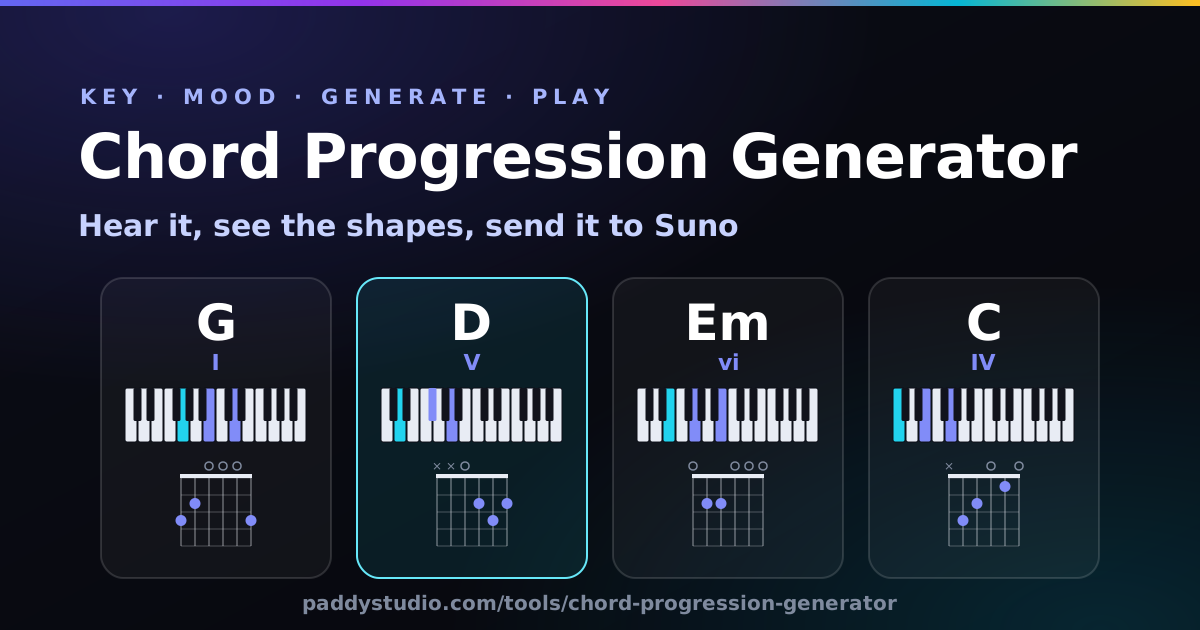
- The most common pop progression is I–V–vi–IV: C–G–Am–F in C major, G–D–Em–C in G major.
- Sad progressions lean on minor chords, such as i–VI–III–VII (Am–F–C–G) or vi–IV–I–V; happy ones start and land on the major I chord.
- V to I is the strongest pull in Western harmony: the V chord contains the leading note, which wants to rise to the tonic.
- To transpose, keep the numerals and change the key. On guitar, a capo does it for you: each fret raises the key by one semitone.
- Suno does not reliably follow exact chords. Key, mood, genre and tempo steer it more; naming the key and progression in the style prompt nudges it.
How to use the chord progression generator
- Pick a key and scale. Any of the 12 keys, in major, natural minor, Dorian or Mixolydian. Sharps and flats are spelled the way the key signature would (B♭ major, not A♯ major).
- Choose a mood. Ten presets, from Happy pop to Dark trap. Each one sets a sensible tempo and playing style and draws from its own library of well-known progressions.
- Press Generate (or G). Choose 3 to 8 chords; shorter library progressions are repeated or extended with a simple functional-harmony walk (tonic, then predominant, then dominant, then home).
- Listen and tweak. Press Play or Space. Lock the chords you like with the padlock, click any chord name to swap it for an alternative, and generate again to replace only the unlocked ones.
- Use it. Copy the Suno style snippet, open it in the Prompt Studio, copy a share link, or star it into your favourites (up to 12, saved in your browser).
What is a chord progression?
A chord progression is the sequence of chords that sits under a melody, usually a short loop that repeats through a verse or chorus. It sets the mood of a song before anyone sings a word. Most pop, rock and folk songs use three to five different chords; jazz and neo-soul use more, and colour them with sevenths and ninths.
Progressions are written in Roman numerals because the numbers describe the relationship between chords rather than the chords themselves. I–IV–V means "the home chord, the chord built on the fourth note, the chord built on the fifth note" in whatever key you are in. That is why one progression can sit behind thousands of different songs.
What do Roman numerals mean in chords?
Each Roman numeral names a scale degree: build a chord on that note of the scale, using only notes from the key, and you get the diatonic chord. Upper case is major, lower case is minor, and ° is diminished. A small 7 adds the seventh (V7, ii7), and a ♭ in front means the chord is borrowed from outside the key (♭VII is B♭ in C major).
| Numeral | I | ii | iii | IV | V | vi | vii° |
|---|---|---|---|---|---|---|---|
| Chord | C | Dm | Em | F | G | Am | Bdim |
| Quality | major | minor | minor | major | major | minor | diminished |
| Job | home | lead-in | soft tonic | lift | tension | sad home | tension |
| Numeral | i | ii° | III | iv | v | VI | VII |
|---|---|---|---|---|---|---|---|
| Chord | Am | Bdim | C | Dm | Em | F | G |
| Quality | minor | diminished | major | minor | minor | major | major |
Same seven chords, different home. C major and A minor share a key signature, so the difference between them is simply which chord feels like the place you land. In minor keys the v chord is often swapped for a major V (E instead of Em in A minor) to get a stronger pull home; the generator offers that as a borrowed chord.
How to transpose a chord progression
Keep the numerals and change the key. I–V–vi–IV is C–G–Am–F in C, G–D–Em–C in G, D–A–Bm–G in D and A–E–F♯m–D in A. Count the same number of scale steps from the new home note and keep each chord's quality. In this tool you just change the Key menu: every chord, note, keyboard and guitar shape is re-spelled for the new key. Got a whole song sheet with lyrics to move? Paste it into the chord transposer, which keeps the lyrics in place and suggests a capo position.
What are the most common chord progressions?
These are the progressions the generator draws from most often. Examples are in C major or A minor; move them to any key with the Key menu.
| Numerals | In C / Am | Mood | Typical genres | Nickname |
|---|---|---|---|---|
| I–V–vi–IV | C G Am F | uplifting, bittersweet | pop, pop-rock, ballads | The four-chord pop song (see Axis of Awesome's "4 Chords" sketch) |
| vi–IV–I–V | Am F C G | emotional, yearning | pop, EDM, ballads | The same four chords, minor first |
| I–vi–IV–V | C Am F G | sweet, nostalgic | doo-wop, 50s and 60s pop | The 50s progression |
| I–IV–V | C F G | bright, simple | blues, rock and roll, country, folk | The three-chord trick |
| ii–V–I | Dm7 G7 Cmaj7 | smooth, resolved | jazz, neo-soul, bossa nova | Jazz ii–V–I |
| I–♭VII–IV | C B♭ F | big, swaggering | classic rock, anthems | The Mixolydian rock move |
| i–VI–III–VII | Am F C G | epic, melancholic | cinematic, pop, synthwave | The epic minor loop |
| i–iv–v | Am Dm Em | dark, plain-spoken | folk, minor blues, ballads | The minor three-chord trick |
| i–VII–VI–V | Am G F E | dramatic, Spanish | flamenco, rock, metal | Andalusian cadence |
| i–VI–VII | Am F G | driving, heroic | rock, film scores, synthwave | — |
| vi–V–IV–V | Am G F G | restless, searching | pop-rock, ballads | — |
| I–V–vi–iii–IV–I–IV–V | C G Am Em F C F G | stately, warm | weddings, ballads, strings | Pachelbel-ish |
Why do some progressions sound happy, sad or tense?
Mostly it comes down to two things: major versus minor, and tension versus release.
- Major and minor. A major chord has a major third (C–E), a minor chord a minor third (A–C). That one semitone is the difference between "bright" and "darker" to most Western ears. Progressions that start and end on a major I sound settled and happy; ones that circle a minor chord sound wistful or sad.
- Tension and release. The V chord (G in C major) contains B, the leading note, which sits a semitone below C and wants to rise to it. So V → I sounds like arriving home, and ending on V sounds like a question. Pop loops that never quite land on I keep you leaning forward.
- Borrowed chords. Pinching a chord from the parallel minor adds instant colour: iv in a major key (Fm in C) sounds bittersweet, ♭VII (B♭) sounds big and rocky, and ♭VI–♭VII–I is the film-trailer lift.
- Secondary dominants. V/vi (E major in C) is the dominant of Am, so it points hard at the vi chord. It is a cheap and lovely way to make a chorus feel like it is leaning into something.
- Sus chords. Swap the third for the second or fourth (Csus2, Csus4) and the chord stops being happy or sad. It just hangs, waiting. Resolve the sus4 down to the third and you get a tiny sigh.
Why I built this
I'm a self-taught guitarist. I learnt most of these progressions by accident before I learnt their names: I'd find three chords that sounded nice on my Cort, play them for a week, and only later discover that half of pop music had found them first. Nobody told me that G, D, Em, C was "I–V–vi–IV". I just knew it worked.
Here's the honest bit. When I started making songs in Suno, I wanted a quick way to try a mood, hear the chords, see the shapes and then hand the whole idea to a prompt without retyping it. So that's what this does. It won't write your song. It will give you a sensible place to start, and occasionally tell you that you've just written the same four chords as everyone else.
How do I get Suno to follow a chord progression?
The short answer is that you can nudge Suno but you can't make it obey. In my experience Suno doesn't reliably follow exact chords. What it does respond to is key, mood, genre and tempo, so those are what the snippet leads with.
- Put the key and progression in the style box. Something like
uplifting pop, key of G major, I–V–vi–IV progression (G D Em C), 112 bpm, acoustic guitar, grand piano. That is exactly what the snippet above builds for you. - Lead with mood and genre. They steer the harmony more than chord names do. "Melancholic piano ballad in A minor" gets you closer to i–VI–III–VII than listing the chords alone.
- Try chord names in the lyrics. Writing chords in square brackets above a line, like
[G] [D] [Em] [C], sometimes helps. Sometimes Suno ignores them. Sometimes it sings them, which is funny once. - Generate a few takes. Expect some to drift. Keep the one that lands closest, and if you play guitar, you can always record the real chords over it.
The Open in Prompt Studio button sends the genre, tempo, moods, instruments and the key-plus-progression text straight into the Prompt Studio style builder, where you can add vocals and structure. For more on prompt wording, see how to write Suno style prompts and blending two genres in Suno.
Tip: Suno sings more comfortably in a key that suits the voice you ask for. If you know your own range, the vocal range test will suggest keys, and the BPM and key finder tells you the key and tempo of a track you already have.
How do I play these progressions on guitar with a capo?
Learn the progression in an easy open key (G, C, D, A, E or Em), then clamp a capo on to move it. Each fret raises everything by one semitone, and your shapes stay the same. The guitar diagrams above show open shapes where they exist and E-shape or A-shape barre chords otherwise; if a barre is beating you up, find the same numerals in G or C and use a capo instead. Tune up first with the guitar tuner (or the ukulele tuner if you are on four strings).
| Capo fret | G shapes | C shapes | D shapes | Em shapes |
|---|---|---|---|---|
| none | G major | C major | D major | E minor |
| 1 | A♭ major | D♭ major | E♭ major | F minor |
| 2 | A major | D major | E major | F♯ minor |
| 3 | B♭ major | E♭ major | F major | G minor |
| 4 | B major | E major | F♯ major | G♯ minor |
| 5 | C major | F major | G major | A minor |
| 7 | D major | G major | A major | B minor |
How it works, and what it does with your data
The generator picks a progression from a hand-curated library for your mood, weighted so the classics come up more often, then pads or trims it to your chord count. Padding uses a simple functional-harmony walk: from the home chord it tends to move to a predominant (ii or IV), then a dominant (V), then home again. Chords are stored as Roman numerals, so changing key just re-spells them, with sharps and flats chosen to match the key signature.
The sound is synthesised in your browser with the Web Audio API: two slightly detuned oscillators through a low-pass filter and an envelope for the keys, and a sine-sweep kick and filtered-noise hi-hat for the beat. It is a sketch pad, not a piano library.
Nothing leaves your device. There is no upload, no account and no server call. Your settings and favourites are kept in your browser's local storage, and the share link simply encodes the key, scale, preset, tempo and numerals in the address so the next person's browser can rebuild it.
Chord progression FAQ
What is a chord progression?
A chord progression is the order in which chords are played in a song, usually as a short loop of three to eight chords that repeats under the verse or chorus. Musicians describe progressions with Roman numerals (I, IV, V, vi and so on) so the same pattern can be played in any key.
What is the most common chord progression in pop music?
I–V–vi–IV is the best-known pop progression: in C major that is C, G, Am, F. Its rotations vi–IV–I–V and IV–I–V–vi are just as common. The comedy group Axis of Awesome famously played dozens of hits over it in their "4 Chords" sketch.
Which chord progressions sound sad?
Progressions that start on or lean on minor chords sound sadder. Good choices are i–VI–III–VII (Am, F, C, G), i–iv–v (Am, Dm, Em), vi–IV–I–V in a major key, and the descending Andalusian cadence i–VII–VI–V (Am, G, F, E). A slow tempo and a soft arpeggio make them sound sadder still.
What do the Roman numerals in a chord progression mean?
Each Roman numeral is a scale degree: I is the chord built on the first note of the key, V on the fifth note, and so on. Upper case means a major chord, lower case means minor, and ° means diminished. In C major the chords are I C, ii Dm, iii Em, IV F, V G, vi Am and vii° Bdim.
How do I transpose a chord progression to a different key?
Keep the Roman numerals and swap the key. I–V–vi–IV is C–G–Am–F in C major, G–D–Em–C in G major and D–A–Bm–G in D major. In this generator, change the Key menu and every chord, note, piano diagram and guitar shape updates automatically. For a full chord sheet with lyrics, use the chord transposer.
Can Suno follow a specific chord progression?
Not reliably. In my experience Suno is steered far more by key, mood, genre and tempo than by exact chords. Putting the key and progression in the style prompt, for example "key of G major, I–V–vi–IV progression (G D Em C)", nudges it, and writing chord names in square brackets in the lyrics sometimes helps, but it is not guaranteed.
How do I play these chord progressions on guitar with a capo?
Learn the progression in an easy open key such as G, C, D, A or E, then move a capo up the neck to change key without changing shapes. Each fret raises the key by one semitone, so G shapes with a capo on fret 2 sound in A major.
Why do some chord progressions sound happy and others tense?
Major chords sound brighter and minor chords darker, and progressions get their pull from tension and release. The V chord contains the leading note, which wants to rise to the tonic, so V to I sounds like coming home. Borrowed chords such as bVII or iv add colour by stepping outside the key.
What does locking a chord do?
Locking a chord keeps it in place when you press Generate again, so you can keep the chords you like and let the generator replace only the rest. Click any chord name to swap it for another diatonic chord, a sus or 7th chord, a borrowed chord or a secondary dominant.
Is this chord progression generator free and private?
Yes. It is free with no signup, and it runs entirely in your browser. The sounds are synthesised on your device with Web Audio, nothing is recorded or uploaded, and your settings and favourites are stored only in your browser's local storage.
How can a chord progression generator help with writer’s block?
Hit Surprise me until a progression makes you feel something, lock the chord you love and regenerate the rest. Then loop it and hum over the top for five minutes without judging yourself. A fresh progression gives a melody somewhere new to go, and the free sheet music maker lets you write the tune down before it escapes.
Is this an AI chord progression maker?
Not quite, and that’s a feature. It uses music-theory rules and weighted randomness that favour the progressions real songs use, so every result is in key, playable and instant, with no account or internet round trip. If you want AI to take it further, copy the progression into a Suno prompt and let an AI band perform a whole song over it.
Got a progression you like?
The free Paddy Prompt Studio turns it into a full Suno style prompt, with genre, mood, instruments, vocals and tempo, ready to paste.
Open the Prompt Studio →