
I learned guitar at fourteen on a borrowed, half-broken instrument, and I still write songs with it on my lap. I also type prompts into an AI music generator and get a full production back before the kettle boils. Both live on my desk, and I genuinely reach for both — which is why the question is never “which one is better?” It is which one suits this song?
The short answer: use an AI music generator when you need a finished, listenable track fast, cheaply, or in many variations. Compose traditionally when the melody already exists in your head, when a person has to perform it, when a client will ask for precise edits, or when human authorship is the point. Most real projects land somewhere in between — and the hybrid is usually the best of the three.
Key takeaways
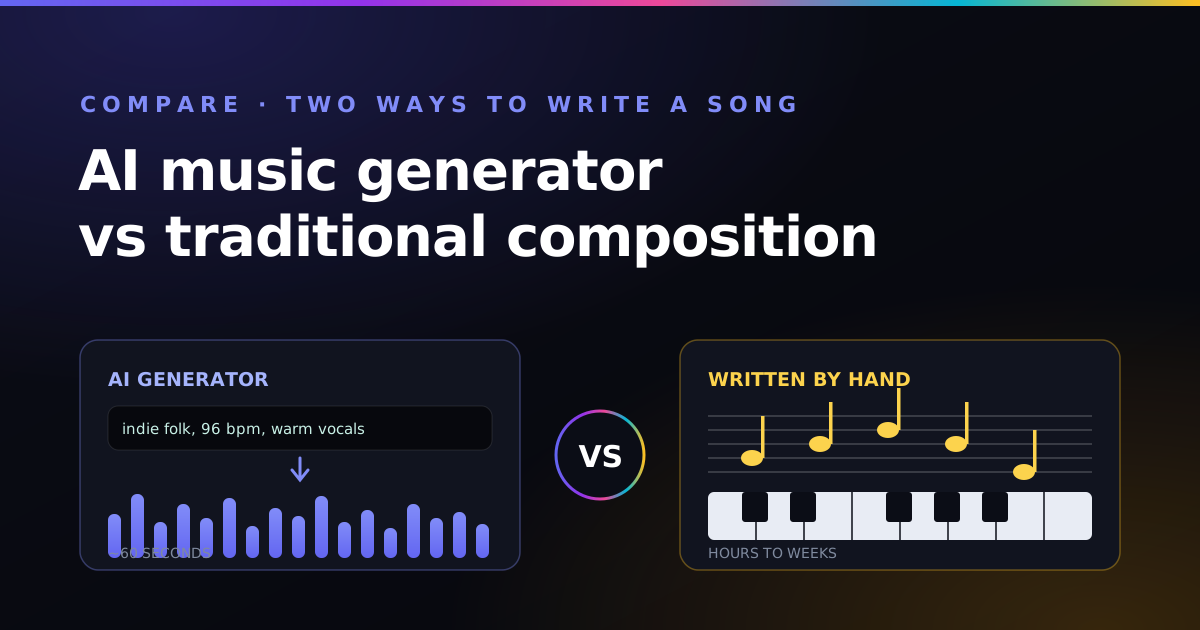
- Speed: a generator gets to a finished mix in about a minute; writing, arranging and mixing by hand takes hours to weeks.
- Control: traditional composition is precise to the note. Prompting is direction, not dictation — you steer, you don’t place.
- Cost: a subscription versus a per-track commission. The gap is large, but you are paying for different things.
- Ownership: selling AI tracks is usually allowed on a paid plan; registering a copyright is a separate, human-authorship question.
- Best answer for most people: write the human parts by hand, let the generator perform and produce them.
- The thing no generator replaces: jamming with your friends on whatever is lying around. That produces a memory, not a track.
What each approach actually means
An AI music generator
You describe the result in words — genre, mood, tempo, instruments, vocal type — and a model trained on huge amounts of audio returns finished stereo music, often with convincing vocals. Suno and Udio are the best-known examples. You never play a note; you direct, judge and re-roll. If you have not tried it yet, my walkthrough on making a song from a text prompt covers the mechanics.
Traditional composition
Everything from humming into your phone to scoring parts for players. In practice it means you choose the notes: writing the melody and chords, arranging the parts, recording or programming them, then mixing. You might do it alone in a bedroom or hire a composer, session players and an engineer. The defining trait is not the gear — it is that a human decides every event in the music.
Side-by-side: the differences that matter
Strip out the arguing and the two approaches split cleanly along nine lines.
| AI music generator | Traditional composition | |
|---|---|---|
| Time to a finished track | About a minute per take; a keeper within an hour | Hours for a demo, days or weeks for a finished production |
| Cost | A monthly subscription, or free on a daily credit allowance | Your time, or a per-track commission that scales with length, players and rights |
| Skill needed | Clear description; no theory or playing required | Writing, arranging, playing or programming, and mixing |
| Control | Directional — you influence the result, you don’t place each note | Absolute — every note, hit and fade is a decision |
| Revisions | Re-roll and hope; targeted fixes are hard | Surgical — “move that chord change one bar later” just happens |
| Consistency | Non-deterministic; the same prompt gives a different song each time | Repeatable; the piece stays exactly as written |
| Sound | Polished and genre-accurate, with a pull toward the average of the genre | As distinctive as the person writing it, for better or worse |
| Rights | Commercial use usually granted by a paid plan; copyright registration is murkier | Clean human authorship; straightforward to register and license |
| Volume | Effectively unlimited — forty variations in an afternoon | Slow and linear; each track costs roughly the same as the last |
Speed is the headline. Control is the catch.
The minute-to-finished-song thing is not hype, and it changes what is worth attempting. A background bed for a video, four alternate intros for a podcast, a rough sketch of a chorus idea at 1 a.m. — all of that used to be a whole evening. Now it is a coffee break.
The catch shows up the moment you want something specific. Prompting is direction, not dictation. You can ask for “a sparse, aching bridge that drops to just piano and voice” and often get it. You cannot say “keep everything, but hold that one note half a beat longer.” The only lever is to change the prompt and generate again — and because the models are non-deterministic, the next take fixes your complaint and moves three things you liked.
This is why an AI-first workflow feels like casting rather than composing. You audition takes until one lands. It is fast and genuinely creative, but the approval is yours, not the placement.
The tell: if you can describe what you want, a generator can probably get you there. If you can only demonstrate it — hum it, play it, point at a bar number — you want to compose it.
What each one really costs
On money, there is no contest. Generators run on a monthly subscription, with a free tier of daily credits for testing; paid plans add credits and the commercial rights you need to publish. Prices move, so check the platform — I keep the current picture in is Suno free?
Commissioned music is priced per track, and the number climbs with length, how many live players you want, and how broad a licence you are buying. A short logo sting sits at the bottom of that range; an original song with real musicians and a full buyout sits far, far above a year of any subscription.
But the honest comparison is not price per track — it is price per outcome. If you need eleven ninety-second beds for a course, the generator wins outright. If you need one piece that must be performed by a string quartet from notated parts, the generator cannot produce the deliverable at any price. You are not buying notes; you are buying a specific form of the notes.
And the hidden cost of AI is real, just not financial: it is listening time. Volume is free, so you can burn an afternoon auditioning forty near-identical takes. A budget of “three takes, then I commit” is worth more than extra credits.
Who owns the result
Two questions get tangled here, so split them.
- Can you sell it? Usually yes, if you generated it on a paid plan. That is a licence the platform grants, and it is the part most people actually need. The detail is in can you sell Suno songs?
- Can you register a copyright on it? Less clear. Several copyright offices, the US among them, require human authorship — so purely machine-generated audio generally is not registrable, while your own contributions, such as lyrics you wrote or your selection and arrangement of material, can be. Rules vary by country and are still moving.
Traditional composition has none of this ambiguity: a human wrote it, so authorship, registration and licensing follow the ordinary path. For a hobby release or a client video, the licence is what matters and AI is fine. For anything where the copyright itself is the asset — a catalogue you intend to sell, a piece whose exclusivity is the product — that clean human authorship is worth paying for.
Platform rules are a separate layer again. Streaming services allow AI-assisted music; what gets pulled is impersonation, voice clones and spam, as I cover in can you put AI music on Spotify?
Where a human still wins
Not as a comfort blanket — these are the practical gaps I hit every month.
- The idea you already have. A melody in your head is the one thing you cannot type. Describing it is a lossy translation; playing it is not.
- Precise revisions. Client notes are nearly always surgical: shorten the intro by two bars, land the hit on the cut. Composition answers that directly. Prompting answers it by starting over.
- Live performance. If anyone has to play the piece, someone has to decide what the parts are and write them down.
- Lyric specificity. AI lyrics are competent and slightly generic. The detail that makes a listener’s neck prickle — a real name, a real room, a real Tuesday — comes from a person. My notes on writing lyrics that sing are mostly about resisting the generic.
- A recognisable identity. Generators pull toward the centre of a genre, because that is what “sounds right” statistically. An artistic voice is a pattern of choices repeated on purpose, and nudging a model toward yours takes real work.
- Jamming with your friends. There is no prompt for a room with other people in it. That one is not a feature gap you can close — see below.
And the one thing no generator will ever give you
The incomparable joy of jamming with your human friends, regardless of whatever instrument we have. A broken guitar? Let’s jam. A pencil as a drum stick, good to go. Nobody is counting bars, nobody is worried about the mix, and half of it falls apart laughing. What you walk away with is not a track — it is the memory created.
That is worth saying plainly in an article like this one, because everything above is a comparison of outputs: how fast, how cheap, how controllable, who owns it. Jamming is not an output. You cannot type it into a prompt box, you cannot re-roll it, and the version with the broken guitar and the pencil is usually better than the one where everybody brought working gear. A generator will hand you a finished, polished song in a minute. It will never hand you that afternoon.
So if the question behind “AI or traditional?” is really should I still bother picking up the instrument, the answer is yes — and not because of the sound quality. Use the generator for the work. Keep the jamming for the reason you got into this in the first place.
Where traditional composition is the wrong tool
The reverse is just as true, and purists skip it.
- Volume. Thirty background cues for a game, in four moods each. Composing that by hand is months.
- Deadlines measured in hours. Client wants music under the edit by tonight.
- Budgets near zero. Small channels, indie games, charity videos, student films.
- Music nobody is meant to notice. A bed under a voiceover has one job: stay out of the way. Craft is mostly wasted there.
- Exploring before committing. Hearing your idea as trap, as folk and as synthwave in ten minutes is genuinely useful, even if you then write the real thing yourself.
Pick by project
The fastest way through this decision is to stop thinking about tools and look at the deliverable.
| Your project | Pick |
|---|---|
| YouTube, podcast or course background music | AI generator. Fast, cheap, cleared for use, easy to produce in several lengths. |
| Social clips and short-form content | AI generator. Volume and trend-speed matter more than authorship. |
| Game or app loops in many moods | AI generator. Generate variations, then hand-edit the loop points. |
| A demo to pitch to a real band | AI as a sketch pad. Get the arrangement idea audible, then have humans play it. |
| A song for your own release or album | Hybrid. Your lyrics and hook, the generator as band and studio. |
| A gift song about real people | Hybrid. The specifics have to be human; the performance does not. |
| Client jingle with brand notes and revision rounds | Traditional, or hybrid with a human mixer. Surgical edits are the whole job. |
| Film or trailer score cut to picture | Traditional. Hitting specific frames needs note-level control. |
| Music that will be performed live | Traditional. Players need parts, not an audio file. |
| A catalogue whose copyright is the asset | Traditional. Clean human authorship is the product. |
| Learning to write music | Traditional. The slow part is the part that teaches you. |
The hybrid workflow I actually use
Almost every song I finish uses both, in the same order every time.
- Write the human parts by hand. Lyrics, the hook, the emotional shape of the song — on guitar or on paper. This is the part no prompt can supply, so it gets my attention first.
- Describe the production, don’t describe the song. The style box gets genre, mood, tempo, two or three signature instruments and a production texture — in that order. The five-part style formula is exactly this.
- Mark the structure myself. Bracketed sections are the one place a generator hands you real control over form, so I never leave it to chance. See structure brackets and vocal tags.
- Generate a few takes and stop. Two or three, then commit and refine one tag at a time rather than rewriting the prompt.
- Finish it like a human record. Trim, master, make artwork, sometimes re-record a real guitar line over the top. This is where an AI track starts sounding like yours.
MINE (written by hand)
[Verse]
You left the porch light on in June
and I still drive past like it means something

MINE (structure + direction)
[Verse] [Pre-Chorus] [Chorus] [Verse] [Bridge] [Chorus] [Outro]

THE GENERATOR'S JOB (style box)
Indie folk, aching but warm, 96 bpm, fingerpicked acoustic guitar,
soft male vocals, brushed drums, intimate room mic, wide stereo
That division of labour is the real answer to the versus question. The generator is not competing with your composing — it is standing in for the session players, the studio and the engineer you cannot afford. Your job moves up a level: deciding what the song is, and judging when a take has it.

Paddy
Self-taught guitarist and independent AI-music hobbyist. Writes songs both ways — by hand on a Cort CR 200 and by prompt with Suno — and publishes the results at /music/.
A 60-second self-test
Still undecided? Answer these five. A single yes in the first three is usually decisive.
- Does the melody already exist in your head? Yes → compose it, or hum it and rebuild it. Typing a description will only frustrate you.
- Will someone ask for a precise change later? Yes → you need note-level control.
- Does a person have to perform it? Yes → traditional, and write the parts down.
- Is it finished today, or does it need several versions? Yes → generator.
- Does it sit under a voice, unnoticed? Yes → generator, and spend your effort on the voice instead.
One trap worth naming: “I’ll just prompt it” is a great way to abandon an idea you actually cared about. If a song matters to you, write the words and the hook yourself first. The generator will still be there, and the result will be twice as good.
Frequently asked questions
Is an AI music generator better than traditional composition?
Neither is better in general — they are good at different jobs. A generator wins when you need a finished, listenable track fast, cheaply, or in many variations: background beds, social content, game loops, quick demos. Traditional composition wins when the exact melody already exists in your head, when the music must be performed live, when a client will ask for precise edits, or when human authorship itself is the point.
Is it cheaper to use an AI music generator than to hire a composer?
Almost always, yes. A generator is a monthly subscription for effectively unlimited output; commissioned music is priced per track and rises with length, live players and the breadth of rights you buy. The maths only flips when the project needs something AI cannot deliver — live performers, notated parts, a guaranteed human-authored copyright — and then you are paying for those, not for the notes.
Can I copyright a song made with an AI music generator?
That is a separate question from whether you can sell it. Selling is usually fine on a paid plan, because the platform licenses it to you. Registration is murkier: several copyright offices, including the US Copyright Office, require human authorship, so purely machine-generated audio generally is not registrable, while your own lyrics or your selection and arrangement of material can be. Rules differ by country and are still developing — check your jurisdiction and your tool’s terms.
Do I need to know music theory to use an AI music generator?
No. You describe the result in plain words and the model handles chords, arrangement and mixing. Theory still helps — knowing tempo, key and song structure lets you give sharper instructions and work out why a take feels wrong — but it is an accelerator, not an entry requirement.
Will AI music generators replace composers?
They are already absorbing a slice of work that was never really composition: cheap background beds, filler loops, disposable stock cues. Work that depends on a specific artistic intention, a live performance, parts for players or a named artist’s identity is much harder to automate. The composers doing best are using generators as a sketch pad and keeping the taste, editing and finishing for themselves.
Can I combine both approaches in one song?
Yes, and it is usually the strongest option. Write the parts only a human can supply — lyrics, hook, emotional arc — then use the generator as your band and studio to perform and produce them. Going one step further and re-recording a real guitar, vocal or keyboard part over the generated track adds the human detail listeners notice most.
Which approach is better for YouTube background music?
A generator, in nearly every case. Background music under a voiceover needs to be unobtrusive, correctly paced, cleared for commercial use and available in several lengths — all of which a generator does in minutes for a flat monthly cost. Save commissioned or self-composed music for the moments your channel’s identity depends on, like a signature theme.
Build the prompt half in a couple of clicks
The free Paddy Prompt Studio turns the “describe the production” step into click-to-build tags — genre, mood, tempo and instruments, assembled in the order generators actually respond to. Keep your lyrics and structure human; let it handle the rest.
Open the Studio →